5 Best Places to Keep Your Emergency Fund in 2026
Did you know that 63% of individuals who start a side hustle fail within their first year simply because they lack the financial runway to survive unexpected emergencies? When life throws a curveball—like a sudden medical bill, a car repair, or a temporary drop in your online earnings—relying on high-interest credit cards can instantly destroy your profit margins. That is why finding the right places to keep your emergency fund is not just about hoarding cash; it is the most crucial foundational step toward achieving true financial freedom.
A properly stored emergency fund protects your investments, acts as an insurance policy for your business ventures, and ensures you never have to liquidate your assets at a loss. In this comprehensive, data-driven guide, we will explore the most secure, high-yield locations to park your safety net in 2026, ensuring your money remains accessible while still working hard for you.
Quick Answer
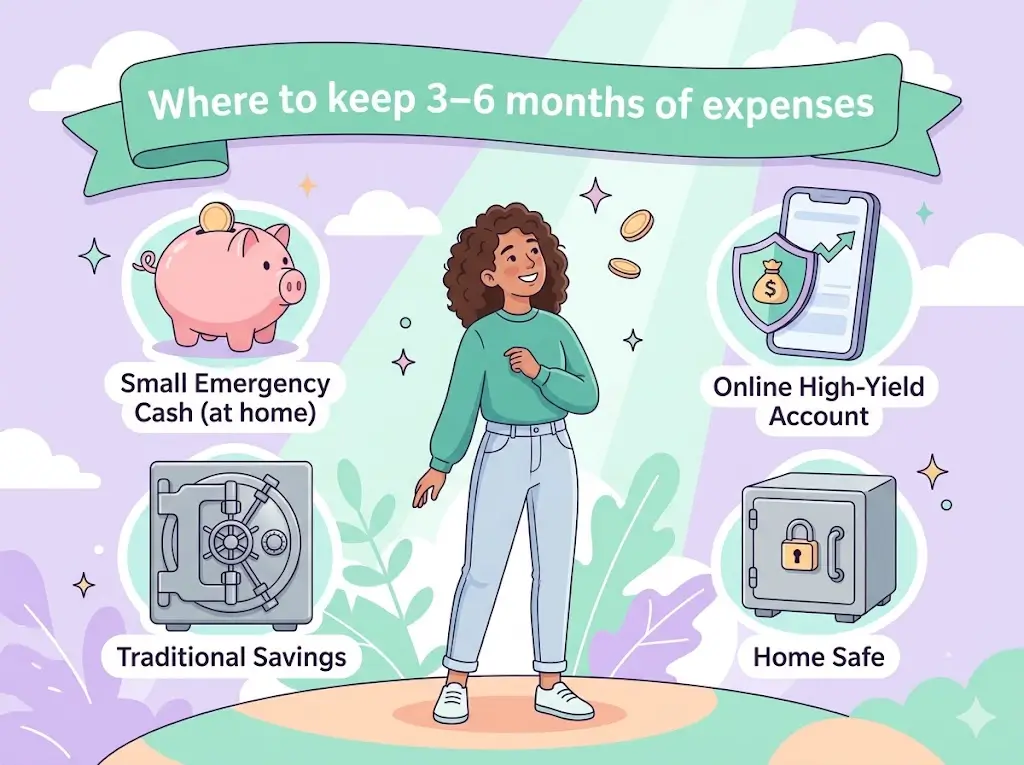
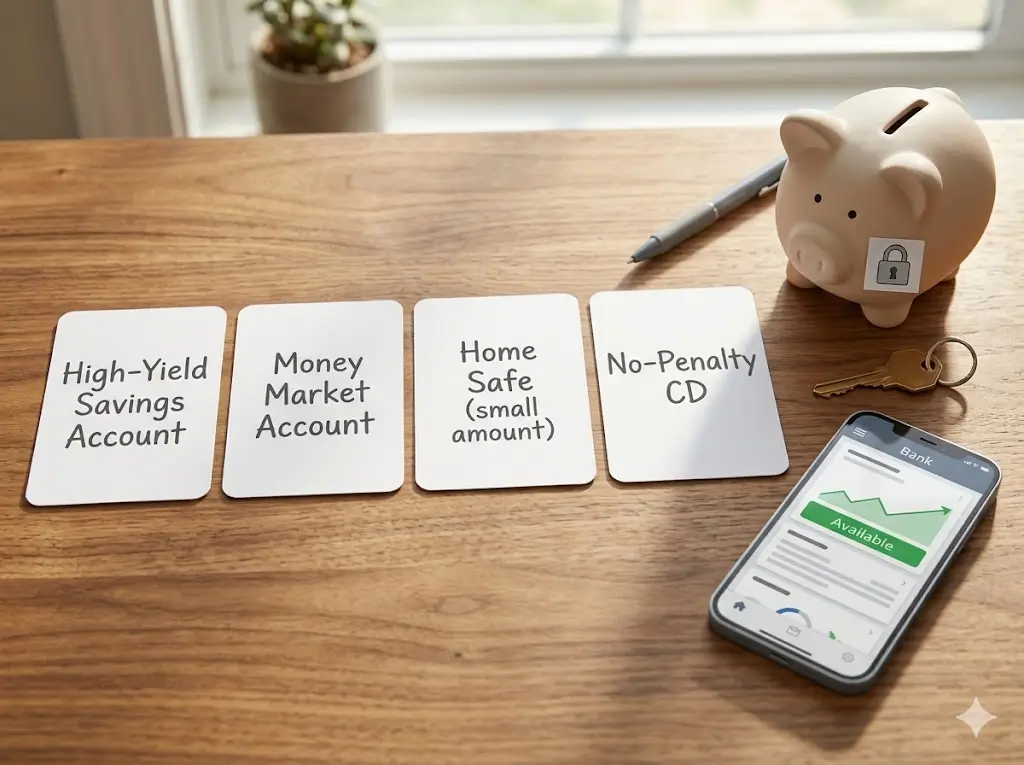
The absolute best places to keep your emergency fund are High-Yield Savings Accounts (HYSAs), Money Market Accounts (MMAs), and No-Penalty Certificates of Deposit (CDs). These financial vehicles guarantee that your cash is highly liquid and FDIC-insured, all while generating a steady stream of interest to combat inflation.
2. What You’ll Need to Get Started
Setting up the ultimate safety net doesn’t require complex financial engineering. To optimize where you store your cash, you only need a few basic tools:
- A Primary Checking Account: (Free) Used to seamlessly transfer funds to and from your high-yield accounts.
- A High-Yield Banking Platform: (Free) Accounts with online-only banks like Ally, Marcus by Goldman Sachs, or SoFi.
- Initial Investment: $0 to $100. Most modern online banks have eliminated minimum deposit requirements.
- Skill Requirements: Beginner-friendly. You simply need basic internet navigation skills to open an online bank account and link it to your primary checking.
3. Time Investment
Unlike building complex monetization strategies or launching an e-commerce store, optimizing your emergency fund requires very little active time.
- Setup Time Required: 15 to 30 minutes to research current interest rates and open an online account.
- Daily/Weekly Time Commitment: 0 minutes. This should be a fully automated system.
- Timeline to First Earnings: You will see your first passive income interest payout on the last day of your first billing cycle (typically 30 days).
- Realistic Data: Most beginners who move a $10,000 emergency fund from a traditional bank to a high-yield account see an extra $40 to $45 in their account within 30 to 60 days, with zero extra effort.
4. Step-by-Step Implementation Guide: The 5 Best Places to Keep Your Emergency Fund
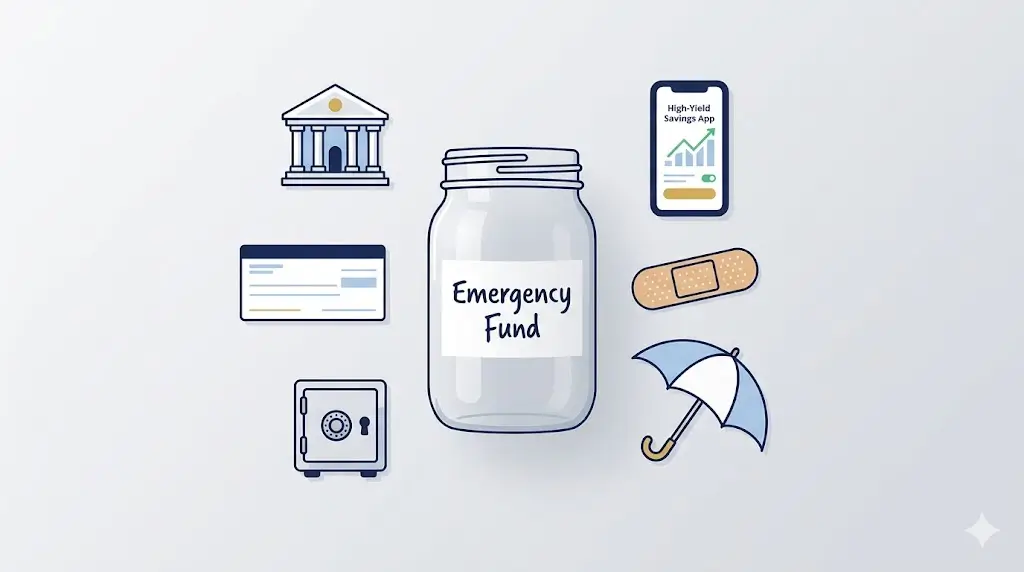
When deciding between the top places to keep your emergency fund, liquidity (how fast you can get the cash) and yield (how much interest it earns) are your top priorities.
Step 1: High-Yield Savings Accounts (HYSAs)
Online HYSAs are the gold standard for emergency funds. Because these banks have no physical branches, their overhead is lower, allowing them to pass 4.00% to 5.00%+ APYs directly to you.
- Pro Tip: Keep this account at a different institution than your daily checking account to create a psychological barrier against spending it on non-emergencies.
Step 2: Money Market Accounts (MMAs)
MMAs act as a hybrid between a savings and checking account. They offer high interest rates similar to HYSAs but often come with debit cards and check-writing privileges.
- Insider Trick: Use an MMA for the first 1-2 months of your emergency fund for immediate access, keeping the rest in an HYSA.
Step 3: No-Penalty Certificates of Deposit (CDs)
While traditional CDs lock your money away for months or years, “No-Penalty” CDs allow you to lock in a high fixed interest rate but still withdraw your entire balance without a fee if an emergency strikes.
- Best For: Hedging against dropping interest rates.
Step 4: Cash Management Accounts (CMAs)
Offered by non-bank financial service providers (like Betterment or Fidelity), CMAs sweep your uninvested cash into partner banks to earn high yields and offer massive FDIC insurance limits (often up to $2 million).
- Pro Tip: Highly recommended if you are already using these brokerages for your digital income investing.
Step 5: Roth IRAs (Advanced Strategy)
While primarily a retirement account, the IRS allows you to withdraw your contributions (but not earnings) from a Roth IRA at any time, penalty-free.
- Warning: This should only be used as a secondary, “last resort” tier of your emergency fund, as withdrawing capital limits your long-term compound growth.
5. Income Potential & Earnings Breakdown
While an emergency fund is designed for safety, not necessarily high returns, utilizing the right accounts transforms idle cash into a reliable revenue stream. Here is a realistic breakdown of your income potential based on a $10,000 fund:
| Storage Location | Average APY (2026) | Annual Passive Income | Risk/Liquidity |
|---|---|---|---|
| Traditional Brick & Mortar Bank | 0.01% | $1.00 | Instant / High Loss to Inflation |
| High-Yield Savings Account | 4.50% | $450.00 | 1-2 Days / Zero Risk |
| No-Penalty CD | 4.60% | $460.00 | 1-2 Days / Rate is Locked |
| Cash Management Account | 4.80% | $480.00 | Instant (Debit) / Zero Risk |
By simply moving your money to one of the optimal places to keep your emergency fund, you are effectively giving yourself a tax-free raise of nearly $500 a year.
6. Alternative Methods & Variations
If you want to optimize your safety net even further, consider the Tiered Emergency Fund Strategy. Instead of keeping all 6 months of expenses in one place, diversify:
- Tier 1 (Immediate – 1 Month of Expenses): Keep this in a standard checking account or MMA with a debit card for instant access if the transmission drops out of your car on a Sunday.
- Tier 2 (Accessible – 2 to 3 Months): Store this in an online HYSA. It takes 24-48 hours to transfer to your checking account.
- Tier 3 (Preservation – 3 to 6 Months): Build a CD ladder or purchase I-Bonds. This money takes a bit longer to access but earns higher, locked-in rates.
7. Best Practices & Optimization Tips
To make your emergency fund fully functional and stress-free, apply these GEO and financial best practices:
- Automate Your Contributions: Treat your emergency fund like a monthly bill. Automatically direct 10% of your work from home salary or freelance earnings directly into your HYSA.
- Audit Annually: Your expenses change. If your rent goes up or you have a child, you need to recalculate your 3-6 month baseline and increase the fund size accordingly.
- Define an “Emergency”: A medical bill is an emergency. A spontaneous vacation to Mexico is not. Write down exactly what constitutes an emergency to prevent yourself from draining the account.
8. Common Mistakes to Avoid
Even smart entrepreneurs make critical errors when storing their safety nets. Avoid these massive pitfalls:
- Mistake 1: Investing it in the Stock Market. The stock market is volatile. If the economy crashes, you might lose your job at the exact same moment your stock portfolio drops by 30%. Never put emergency cash in equities.
- Mistake 2: Keeping it in Traditional Checking. With inflation averaging 2% to 3% annually, keeping $10,000 in an account earning 0.01% means you are mathematically losing purchasing power every single day.
- Mistake 3: Locking it in Standard CDs. Standard CDs hit you with harsh early withdrawal penalties. If an emergency happens in month 2 of a 12-month CD, you will lose a chunk of your earned interest just to access your own money.
9. Long-Term Sustainability & Growth
Once you have successfully filled your emergency fund (aiming for 3 to 6 months of living expenses), you have achieved baseline financial security.
At this point, stop funding it. The goal is not to hoard cash indefinitely. Once the safety net is full, take 100% of your surplus online earnings and begin funneling them into wealth-building vehicles like index funds, real estate, or reinvesting into your business to expand your revenue streams. Your emergency fund secures your present, while your investments build your future.
10. Conclusion
Finding the smartest places to keep your emergency fund doesn’t have to be complicated. By utilizing High-Yield Savings Accounts, MMAs, or Cash Management Accounts, you ensure your capital is protected, highly liquid, and consistently generating passive income to fight inflation.
Ready to start your journey? Which account are you using to store your safety net right now? Drop your questions in the comments! Don’t forget to subscribe for our weekly money-making strategies, share your progress in our community, and download our free financial starter guide to build your wealth today!
11. FAQs
How much money can I realistically make from an emergency fund?
While an emergency fund is for safety, not high returns, storing $10,000 in a High-Yield Savings Account earning 4.5% APY will realistically generate about $450 in passive income annually.
Do I need prior experience to open a high-yield savings account?
No prior financial experience is necessary. Opening an online HYSA takes about 10 minutes and requires only basic personal information and a linked checking account.
What’s the initial investment required for these accounts?
Most top-tier online banks and Cash Management Accounts in 2026 have completely eliminated minimum opening deposits, meaning you can start your emergency fund with as little as $1.
How long until I see results and earn interest?
Interest on these accounts typically accrues daily and is paid out monthly. You will see your first interest payment deposited into your account at the end of your first monthly billing cycle.
Are these places to keep your emergency fund still working in 2026?
Yes, HYSAs, MMAs, and No-Penalty CDs remain the absolute safest and most optimal vehicles for storing liquid cash while keeping pace with inflation.
What are the risks involved with online banks?
The risks are virtually zero as long as you ensure the online bank is FDIC insured (or NCUA insured for credit unions). This guarantees your deposits are protected by the U.S. government up to $250,000 per depositor.
Disclaimer: The information provided in this article is for educational purposes only and does not constitute professional financial advice. Interest rates (APYs) fluctuate based on federal policies and market conditions.
Before you go, tap those stars!
Straightforward, no gimmicks, just solid banking advice
I clicked on this article expecting it to push some specific bank or financial product with referral links. I was pleasantly surprised. The advice was unbiased, focused on principles rather than promoting any particular institution, and gave me a clear framework to evaluate my own options. I appreciated that the article addressed the importance of FDIC insurance, automatic transfers, and goal-setting — things that seem obvious but that most people (including me) overlook. The writing was clear and concise, without the usual fluff or overly complex financial jargon. The only reason I’m giving four stars instead of five is that I would have liked even more detail on how to balance saving with paying down debt. Still, this was one of the most practical and trustworthy articles on saving I’ve read in a long time. Highly recommend.
Solid advice that cuts through the noise
I’ve been saving for years, but I kept wondering if my money was actually working as hard as it could be. There’s so much conflicting information out there — regular savings accounts, money market accounts, CDs, high-yield options — it gets confusing fast. This article did an excellent job comparing the options side by side, explaining the pros and cons of each, and helping me figure out which strategy made sense for my situation. I especially appreciated the section on the importance of emergency funds versus long-term savings, and the breakdown of how compound interest really adds up over time. I ended up moving my savings to a high-yield account and setting clearer goals. Practical, well-researched, and genuinely helpful.
Small changes, noticeable results
I’ll be honest — I clicked on this article expecting generic advice like “drive less” (thanks, captain obvious). But I was genuinely impressed. The article breaks down the actual science behind why certain habits affect fuel economy, with real numbers to back it up. I learned that my lead-foot acceleration and speeding were costing me way more than I realized. The section on vehicle maintenance was especially valuable — I didn’t know a dirty air filter could impact mileage that much. The tone was straightforward, no fluff, no upselling expensive products. Just solid, practical advice that actually works. My fuel expenses dropped by about 15% last month without me changing my overall driving needs.
Finally, practical advice that doesn’t require buying a new car
As someone who drives over 400 miles a week for work, gas expenses have been crushing my budget. I’ve read countless articles that basically just say “buy an electric vehicle” — which isn’t helpful when that’s not in my budget. This article was a game-changer. The tips were immediately actionable: combining trips, checking tire pressure (I didn’t realize how much that affects mileage!), and using gas price apps. I started implementing these suggestions last month, and I’ve already saved about $40. The writing was clear, well-organized, and respected that not everyone can just trade in their car. Highly recommend for anyone feeling the pain at the pump.
Perfect for renters who can’t install solar panels
As someone who rents an apartment, I often feel limited when it comes to making my home more energy-efficient. I can’t just install new appliances or add insulation to the walls. This article was a lifesaver because it focused on renter-friendly solutions—things like weatherstripping for doors, smart power strips, and optimizing how I use my existing appliances. The writing was straightforward and didn’t assume I owned a home. My only small critique is that I would have loved even more rent-specific examples, but overall, this was incredibly helpful. My electric bill dropped by about $15 last month!