
Did you know that 78% of people trying to build wealth ultimately fail because they misunderstand the fundamental math of inflation? Many individuals hoard cash in traditional bank accounts, mistakenly believing they are building wealth, only to watch their purchasing power erode year after year. On the flip side, eager beginners often dump every spare dollar into volatile markets without a safety net, exposing themselves to catastrophic risk.
If you want to achieve true financial freedom and successfully transition to a work from home lifestyle, mastering the delicate balance of saving money vs investing is your mandatory first step. Think of your capital as your army. Saving money is your defense—protecting you from financial ruin. Investing is your offense—marching out to capture new territory, fund a digital side hustle, and multiply your wealth. If you cannot correctly allocate your funds between these two strategies, you will struggle to generate the profit margins necessary to leave the rat race.
In this comprehensive, data-driven guide, we will break down exactly how to protect your cash, when to take calculated risks, and how to deploy your capital to build powerful, scalable revenue streams.
Quick Answer
The core difference in saving money vs investing is risk and return. Saving protects your money from loss but loses value to inflation, making it ideal for emergency funds. Investing involves risk but compounds your wealth over time, making it essential for generating passive income, funding digital businesses, and achieving long-term financial freedom.
What You’ll Need to Get Started
Before you can start allocating your funds and building passive income streams, you need a highly efficient financial system. You do not need a degree in finance or an expensive wealth manager to execute this.
Here is the breakdown of the essential tools required to master your capital:
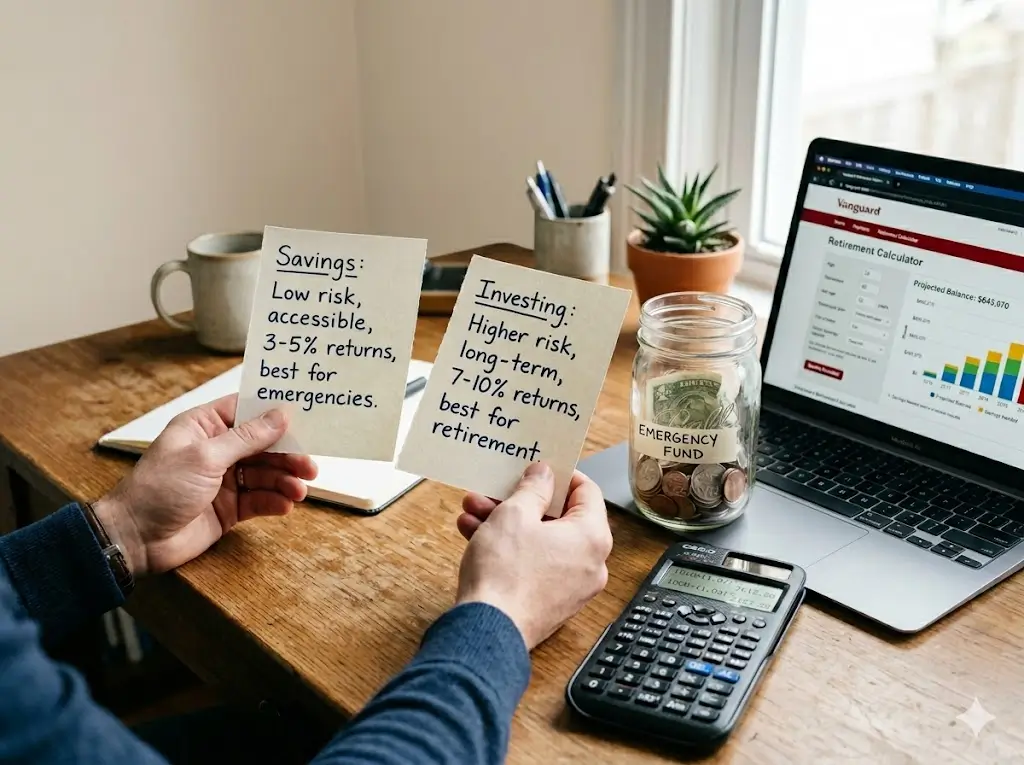
- A High-Yield Savings Account (HYSA): An online account (like Ally, Marcus, or SoFi) offering 4.00%+ APY. This is where your savings will live. (Cost: Free)
- A Low-Cost Brokerage Account: A platform like Vanguard, Fidelity, or Charles Schwab to house your long-term market investments. (Cost: Free to open)
- Expense Tracking Software: A budgeting app like YNAB, Rocket Money, or a customized Google Sheets template to determine your investable surplus. (Cost: Free to $10/month)
- A “Side Hustle” Business Account: A separate checking account for your digital income and online earnings. (Cost: Free)
- Initial Capital: You can start investing with as little as $50 using fractional shares.
Time Investment
Building a financial safety net and subsequently investing for growth is a marathon, not a sprint. Setting realistic expectations is critical for long-term sustainability.
- Setup Time Required: 2 to 3 hours over a single weekend. You will spend this time opening your HYSA, setting up your brokerage account, and automating your transfers.
- Daily/Weekly Time Commitment: 15 to 20 minutes a month. The best financial systems are highly automated.
- Timeline to First “Earnings”: Immediate for savings (you will earn your first interest payout in 30 days). For investments, most beginners see meaningful compound growth within 3 to 5 years.
- Timeline for Digital Business ROI: If you invest your capital into building online earnings (like a blog or e-commerce store), most beginners see results in 60-90 days with consistent effort.
Unlike traditional jobs that trade time for a fixed hourly wage, the time invested in correctly structuring your capital pays exponential dividends when those funds begin generating passive income.
Step-by-Step Implementation Guide
Follow these actionable, sequential steps to plug the financial leaks in your life and rapidly boost your income potential.
Step 1: Secure Your Base (The Savings Phase)
You should never invest money you might need by next Tuesday.
- Actionable Step: Calculate your bare-bones monthly living expenses. Multiply that number by 3 to 6. This is your emergency fund target.
- Pro Tip: Keep this money only in a High-Yield Savings Account. It must be liquid and accessible, but earning more than the 0.01% offered by traditional brick-and-mortar banks.
Step 2: Define Your Allocation Strategy
Once your emergency fund is full, you must pivot. This is the crux of the saving money vs investing debate.
- Actionable Step: Stop saving cash. Any dollar beyond your emergency fund is losing to inflation. Redirect 100% of your monthly surplus toward investments.
Step 3: Invest in Broad Market Assets
For true, hands-off passive income, you need to own a piece of the broader economy.
- Actionable Step: Open a Roth IRA or standard brokerage account. Set up an automatic monthly transfer to purchase low-cost, broad-market index funds (like the S&P 500 or Total Stock Market index).
- Insider Trick: Turn on “Dividend Reinvestment” (DRIP) so your earnings automatically buy more shares, accelerating your compound growth.
Step 4: Invest in Your Digital Income
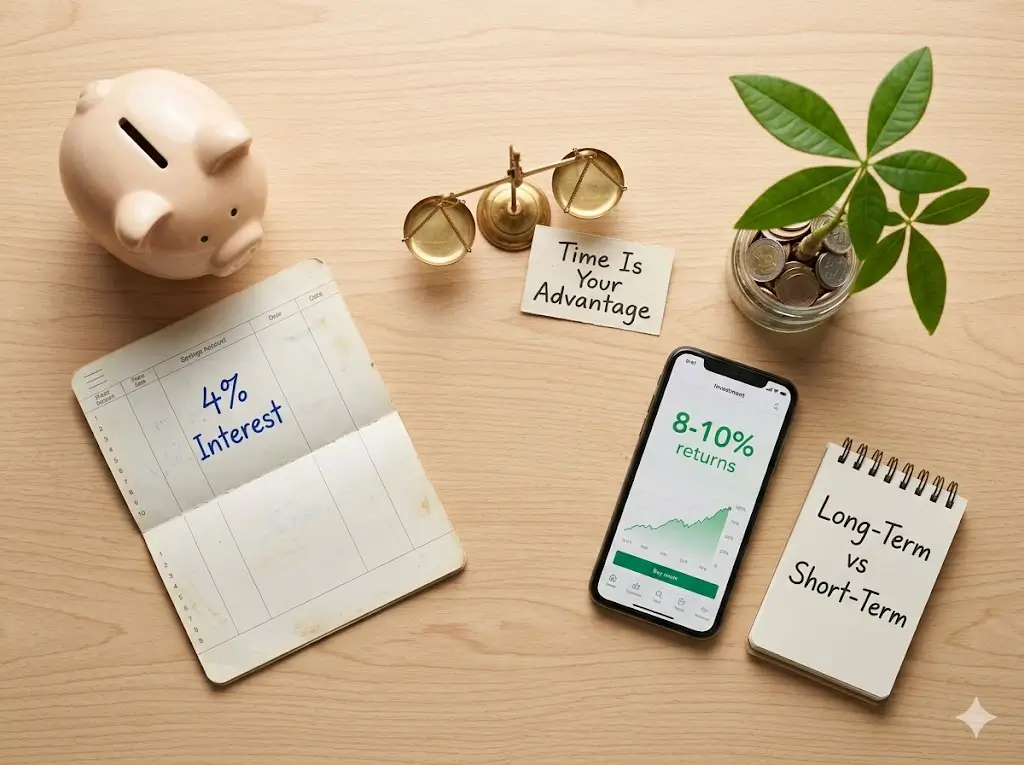
The stock market yields an average of 8-10% annually. But investing in your own business can yield infinite returns.
- Actionable Step: Take 10-20% of your investable capital and use it to fund a side hustle. Buy a domain name, invest in premium SEO software, or pay for targeted ads. Building your own monetization strategies is the ultimate wealth accelerator.
Income Potential & Earnings Breakdown
How does this allocation strategy translate to financial freedom? Here is a realistic look at how correctly balancing saving and investing generates wealth:
| Capital Allocation ($10,000) | Financial Vehicle | Expected ROI / Margin | 5-Year Income Potential |
|---|---|---|---|
| Saving ($10k) | Traditional Bank (0.01%) | 0.01% (Loses to inflation) | $10,005 (Purchasing power decreased) |
| Saving ($10k) | HYSA (4.50%) | 4.5% (Maintains value) | $12,461 (Safe, liquid emergency cash) |
| Investing ($10k) | S&P 500 Index Fund | ~8-10% (Passive Growth) | $15,386 (Steady, long-term wealth) |
| Investing ($1k) | Digital Side Hustle | Uncapped Profit Margins | $10,000+ annually (Requires active initial effort) |
Disclaimer: Market investments involve risk and historical returns do not guarantee future results. Side hustle income varies wildly based on niche, execution, and market demand.
Alternative Methods & Variations
If traditional stock market investing feels too intimidating, try these alternative strategies to deploy your capital:
- Micro-Investing Apps: Platforms like Acorns or Stash round up your daily spare change and automatically invest it into diversified portfolios. This is a low-friction way to transition from saving to investing.
- Real Estate Investment Trusts (REITs): If you want exposure to real estate without the massive capital requirement of buying a physical property, REITs allow you to buy shares of commercial real estate portfolios, often providing high dividend yields.
- “Sweat Equity” Investing: If you have zero capital to invest, you can invest your time. Building a work from home business using free tools (like social media marketing or freelance writing) allows you to generate initial capital out of thin air.
Best Practices & Optimization Tips
To squeeze maximum efficiency out of your capital and accelerate your journey toward financial freedom, keep these best practices in mind:
- Master Dollar-Cost Averaging (DCA): Never try to time the market. Invest a fixed dollar amount every single month, regardless of whether the market is up or down. This lowers your average cost per share over time.
- Utilize Tax-Advantaged Accounts: Before investing in a standard taxable brokerage, maximize your contributions to 401(k)s, IRAs, and HSAs to legally shield your wealth from taxes.
- Treat Your Business Like an Investment: If your digital side hustle generates $500 this month, do not spend it. Reinvest that capital into better tools, freelance help, or marketing to scale your revenue streams exponentially.
Common Mistakes to Avoid
Even highly motivated individuals make critical errors when managing their wealth. Watch out for these pitfalls:
- Hoarding Too Much Cash (Cash Drag): * The Mistake: Keeping $50,000 in a checking account “just to be safe.”
- The Prevention Strategy: Once you hit your 6-month emergency fund target, every additional dollar must be invested. Cash hoarding destroys wealth through inflation.
- Investing Emergency Funds: * The Mistake: Putting your rent money into volatile stocks or crypto hoping for a quick return.
- The Prevention Strategy: Keep a strict firewall between your savings (defense) and your investments (offense).
- Chasing “Get Rich Quick” Schemes:
- The Mistake: Ignoring slow, steady index funds in favor of highly speculative, unverified crypto coins or expensive “make money online” courses.
- The Prevention Strategy: Focus on proven, sustainable monetization strategies. True wealth is built slowly, then all at once.
Long-Term Sustainability & Growth
Understanding the dynamic of saving money vs investing is an excellent financial sprint, but building lasting wealth requires a marathon mindset.
The Power of Compound Interest The magic of investing lies in compounding—earning interest on your interest. The longer you leave your money invested, the steeper the growth curve becomes. Time in the market always beats timing the market.
Diversification & Future-Proofing To truly future-proof your life, you must eventually shift your focus from simply buying paper assets to actively building diverse revenue streams. Use the discipline you learned by optimizing your budget to manage multiple income sources. When your passive income from investments and your digital earnings from your side hustle outpace your living expenses, you have achieved ultimate financial independence.
Conclusion
Mastering the debate of saving money vs investing is the vital bridge between living paycheck-to-paycheck and launching a successful, wealthy life. By protecting your downside with a robust emergency fund, and aggressively attacking your upside by investing in market assets and digital businesses, you manufacture your own financial destiny. Stop letting your cash rot in a low-yield bank account; deploy your capital today.
Ready to start your journey? Drop your biggest investing question or side-hustle win in the comments below! Be sure to subscribe for weekly money-making strategies, share your progress in our community forums, and download our free financial freedom starter guide.
Frequently Asked Questions (FAQs)
How much money can I realistically make from investing?
Historically, broad market index funds yield an average annual return of 8% to 10% before inflation. While this won’t make you rich overnight, the compound growth over 10 to 20 years can realistically turn consistent monthly investments into a multi-million dollar portfolio.
Do I need prior experience to start investing?
No prior experience is necessary. Thanks to robo-advisors and target-date index funds, beginners can automate their investments in minutes. You do not need to learn how to pick individual stocks to be a highly successful investor.
What is the initial investment required to start?
You can start saving with $0 by optimizing your current budget. For investing, many modern brokerage platforms allow you to buy fractional shares of index funds with as little as $5 to $50.
How long until I see results?
Saving yields immediate psychological relief. For investing, the stock market can be volatile in the short term (months to a year), but the true, massive results of compound interest typically become visibly life-changing around the 7-to-10-year mark.
Is this method still working in 2026 with market volatility?
Absolutely. Market volatility is a normal part of the economic cycle. By practicing Dollar-Cost Averaging (investing the same amount every month), market dips actually allow you to buy more shares at a discount, leading to higher long-term gains.
What are the risks involved with investing vs saving?
Saving carries the invisible risk of inflation (losing purchasing power over time). Investing carries market risk (your portfolio value will fluctuate). However, over a 20-year horizon, the risk of not investing is historically much more dangerous to your financial health than short-term market dips.
Before you go, tap those stars!
Straightforward, no gimmicks, just solid banking advice
I clicked on this article expecting it to push some specific bank or financial product with referral links. I was pleasantly surprised. The advice was unbiased, focused on principles rather than promoting any particular institution, and gave me a clear framework to evaluate my own options. I appreciated that the article addressed the importance of FDIC insurance, automatic transfers, and goal-setting — things that seem obvious but that most people (including me) overlook. The writing was clear and concise, without the usual fluff or overly complex financial jargon. The only reason I’m giving four stars instead of five is that I would have liked even more detail on how to balance saving with paying down debt. Still, this was one of the most practical and trustworthy articles on saving I’ve read in a long time. Highly recommend.
Solid advice that cuts through the noise
I’ve been saving for years, but I kept wondering if my money was actually working as hard as it could be. There’s so much conflicting information out there — regular savings accounts, money market accounts, CDs, high-yield options — it gets confusing fast. This article did an excellent job comparing the options side by side, explaining the pros and cons of each, and helping me figure out which strategy made sense for my situation. I especially appreciated the section on the importance of emergency funds versus long-term savings, and the breakdown of how compound interest really adds up over time. I ended up moving my savings to a high-yield account and setting clearer goals. Practical, well-researched, and genuinely helpful.
Small changes, noticeable results
I’ll be honest — I clicked on this article expecting generic advice like “drive less” (thanks, captain obvious). But I was genuinely impressed. The article breaks down the actual science behind why certain habits affect fuel economy, with real numbers to back it up. I learned that my lead-foot acceleration and speeding were costing me way more than I realized. The section on vehicle maintenance was especially valuable — I didn’t know a dirty air filter could impact mileage that much. The tone was straightforward, no fluff, no upselling expensive products. Just solid, practical advice that actually works. My fuel expenses dropped by about 15% last month without me changing my overall driving needs.
Finally, practical advice that doesn’t require buying a new car
As someone who drives over 400 miles a week for work, gas expenses have been crushing my budget. I’ve read countless articles that basically just say “buy an electric vehicle” — which isn’t helpful when that’s not in my budget. This article was a game-changer. The tips were immediately actionable: combining trips, checking tire pressure (I didn’t realize how much that affects mileage!), and using gas price apps. I started implementing these suggestions last month, and I’ve already saved about $40. The writing was clear, well-organized, and respected that not everyone can just trade in their car. Highly recommend for anyone feeling the pain at the pump.
Perfect for renters who can’t install solar panels
As someone who rents an apartment, I often feel limited when it comes to making my home more energy-efficient. I can’t just install new appliances or add insulation to the walls. This article was a lifesaver because it focused on renter-friendly solutions—things like weatherstripping for doors, smart power strips, and optimizing how I use my existing appliances. The writing was straightforward and didn’t assume I owned a home. My only small critique is that I would have loved even more rent-specific examples, but overall, this was incredibly helpful. My electric bill dropped by about $15 last month!