Biweekly Money Saving Challenge for Paycheck Budgeters: Fund Your Financial Freedom
Did you know that 67% of aspiring online entrepreneurs fail before they even launch, simply because they lack the initial startup capital? It is a harsh reality: building a work from home business or generating passive income requires a financial runway. But what if you could build that runway simply by optimizing your current paycheck?
If you get paid every two weeks, the standard monthly budget often leaves you feeling out of sync with your cash flow. Enter the Biweekly Money Saving Challenge. This tailored strategy aligns perfectly with your pay schedule, turning every payday into an opportunity to increase your personal profit margins.
In this comprehensive guide, we will break down how to use the Biweekly Money Saving Challenge to effortlessly accumulate the tax-free seed capital you need. Whether your ultimate goal is to fund a new side hustle, invest in digital income assets, or simply build an impenetrable safety net, mastering this challenge is your first step toward true financial freedom.
What You’ll Need to Get Started
You don’t need expensive financial software or an accounting degree to take control of your 26 paychecks a year. The Biweekly Money Saving Challenge is designed for absolute beginners.
Here is your essential toolkit:
- A “Capital” Holding Account: A free, High-Yield Savings Account (HYSA) completely separate from your daily checking account.
- Biweekly Tracking System: A printable 26-pay period checklist, a free app like EveryDollar, or a simple Google Sheets template.
- Bank/Credit Card Statements: Access to your last two months of spending to establish a baseline.
- Initial Investment: $0. You are simply reallocating the money you already make.
- Skill Requirements: Basic self-discipline, fundamental math skills, and the ability to set up automatic bank transfers.

Time Investment
Unlike building complex online earnings streams that can take months to set up, optimizing your expenses yields an immediate, guaranteed return on your time.
- Setup Time Required: 30 to 45 minutes to review your cash flow and set up your tracking sheet.
- Biweekly Time Commitment: 10 to 15 minutes on each payday to transfer funds and log your progress.
- Timeline to First Results: Immediate. The moment you transfer your first biweekly deposit, you have successfully generated retained “profit.”
- Realistic Expectations: Most beginners see a profound shift in their financial confidence within 60-90 days, successfully building enough capital to fund their first low-cost monetization strategies.
Step-by-Step Implementation Guide
Follow these actionable steps to execute the Biweekly Money Saving Challenge successfully and build your digital income seed fund.
Step 1: Calculate Your Biweekly Baseline
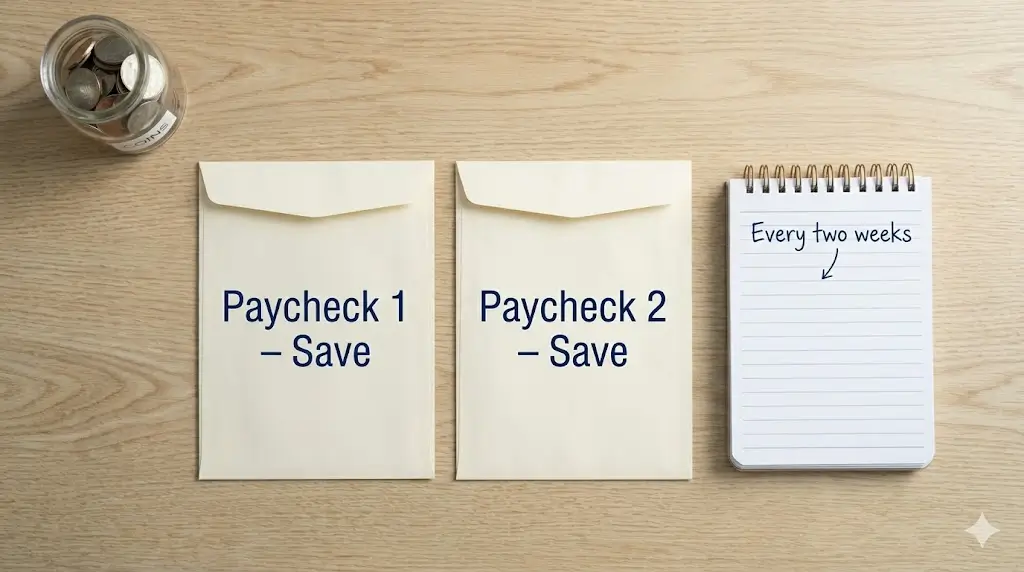
Before you can save, you need to know your numbers. Divide your fixed monthly expenses (rent, insurance, internet) in half. Because you are paid biweekly, half of these bills should be assigned to Paycheck 1, and the other half to Paycheck 2. This instantly smooths out your cash flow and prevents the dreaded “end-of-month broke” feeling.
Step 2: Choose Your Challenge Structure
A year has 52 weeks, which means you receive 26 paychecks. You can structure your challenge in two ways:
- The Fixed Biweekly Method: Save a flat rate (e.g., $100) from every single paycheck.
- The Progressive 26-Paycheck Method: Save $5 from paycheck 1, $10 from paycheck 2, adding $5 each period until you save $130 on paycheck 26.
- Pro Tip: Choose the method that best fits your current income potential. If your income fluctuates, a percentage-based approach (saving 10% of every check) might work best.
Step 3: Automate the “Payday Sweep”
The secret to the Biweekly Money Saving Challenge is eliminating willpower. Log into your employer portal or banking app and set up a direct deposit split. Route your challenge amount directly into your HYSA before the rest hits your checking account.
Step 4: Weaponize the “Magic Months”
Because there are 52 weeks in a year, you receive 26 paychecks. That means twice a year, you will receive a month with three paychecks. Treat this third paycheck as pure profit.
- Insider Trick: Use these “magic” third paychecks to aggressively fund the launch of your online business or maximize your investment accounts.
Step 5: Protect the Capital
When your account hits $500 or $1,000, the temptation to spend it will skyrocket. Remember your “why.” This money is strictly for funding your future revenue streams, not for consumer purchases.

Income Potential & Earnings Breakdown
In personal finance, a dollar saved is actually worth more than a dollar earned because it is post-tax money. By treating your personal finances like a business, every dollar you keep boosts your personal profit margins.
Here is a realistic projection of what you can achieve during a 1-year Biweekly Money Saving Challenge (based on 26 pay periods):
| Saving Strategy | Amount per Paycheck | Annual “Tax-Free” Capital Generated |
|---|---|---|
| The Beginner Tier | $25 per paycheck | $650 |
| The Progressive Tier | $5 to $130 | $1,755 |
| The Side Hustle Funder | $100 per paycheck | $2,600 |
| The Aggressive Saver | $250 per paycheck | $6,500 |
Disclaimer: These figures are projections. Your ability to save depends on your local cost of living and current debt obligations.
Alternative Methods & Variations
If the standard progressive model doesn’t fit your lifestyle, try these niche-specific variations to fund your work from home lifestyle:
- The Reverse Biweekly Challenge: Start with your highest savings amount on Paycheck 1 (e.g., $130) and decrease the amount by $5 every pay period. This is perfect for those highly motivated at the beginning of the year.
- The “Side Hustle Match” Variation: Challenge yourself to match your paycheck savings with active side hustle income. If you save $50 from your paycheck, you must generate $50 in online earnings (via freelancing or gig work) to deposit alongside it.
- The $5 Bill Challenge: Every time you receive a $5 bill in change over the two-week period, you cannot spend it. Deposit all accumulated $5 bills into your capital fund on payday.
Best Practices & Optimization Tips
To maximize your revenue streams from this challenge, integrate these optimization strategies:
- Leverage the Right Tools: Use cashback credit cards (paid off in full every two weeks) for essential spending. Route all cashback rewards directly into your biweekly challenge fund to accelerate your progress.
- Audit Your Subscriptions: Every quarter, review your bank statement. Cancel any software or streaming service you haven’t used in the last 14 days and roll that money into your savings amount.
- Advanced Growth: Once your savings account hits your initial goal, move the capital into low-cost index funds or use it to pay for high-ROI digital marketing tools for your business.
Common Mistakes to Avoid
Even smart budgeters make critical errors when trying to cut costs. Avoid these pitfalls:
- Leaving Savings in Checking: If you leave your biweekly savings in your main checking account, you will accidentally spend it. Out of sight, out of mind is mandatory.
- Extreme Deprivation: Cutting all entertainment and hobbies at once leads to “rebound spending.” Keep a small, guilt-free allowance in your biweekly budget to ensure the challenge is sustainable.
- Forgetting to Adjust for Inflation: As your salary grows or inflation rises, your biweekly savings amount should adapt. Never let your lifestyle inflate faster than your savings rate.
Long-Term Sustainability & Growth
Completing a one-year Biweekly Money Saving Challenge is a massive achievement, but what you do next dictates your financial future.
- Reinvestment Strategies: Do not let your newly acquired capital stagnate. Deploy it. Use the funds to purchase inventory for an e-commerce store, buy dividend-paying stocks, or invest in courses that increase your earning potential.
- Diversification: Once you have mastered your outgoing expenses, shift your focus. Your ability to cut costs has a floor, but your income potential has no ceiling. Transition from “saving mode” to “earning mode” by scaling up your side hustle.
- Future-Proofing: Make the biweekly transfer a permanent fixture of your life. Automatically routing capital into investments every two weeks is the ultimate secret to building long-term generational wealth.
Conclusion
The Biweekly Money Saving Challenge is far more than a simple budgeting trick; it is a systematic framework for aligning your cash flow with your goals. By working with your pay schedule instead of against it, you can effortlessly generate the seed capital required to unlock true financial freedom.
Ready to start your journey? What side hustle are you planning to fund with your biweekly savings? Drop your goals in the comments below! Don’t forget to subscribe for our weekly monetization strategies, and share your progress in our community.
FAQs
How much money can I realistically make or save with this challenge?
If you save just $50 per paycheck, you will generate $1,300 in a year. Many paycheck budgeters successfully save between $1,500 and $3,000 annually simply by optimizing their biweekly cash flow.
Do I need prior experience with budgeting?
Not at all. This challenge is incredibly beginner-friendly. Because you are matching the challenge to your natural payday, the math is much simpler than traditional monthly budgeting.
What’s the initial investment to start this challenge?
Zero. This method requires no financial investment. You are simply reallocating and retaining the money you are already earning.
How long until I see results?
You will see tangible results on your very first payday when you transfer your funds into your savings account. Psychological momentum builds within the first month.
Is this method still working in 2026?
Absolutely. In fact, amidst fluctuating economic conditions, optimizing your personal profit margins through active biweekly expense management is one of the most reliable ways to secure financial stability.
What are the risks involved?
There is zero financial risk, as you are keeping your own money. The only risk is “budget burnout,” which occurs if you restrict your spending too severely. Ensure you maintain a small budget for personal enjoyment to keep the challenge sustainable.
Before you go, tap those stars!
Straightforward, no gimmicks, just solid banking advice
I clicked on this article expecting it to push some specific bank or financial product with referral links. I was pleasantly surprised. The advice was unbiased, focused on principles rather than promoting any particular institution, and gave me a clear framework to evaluate my own options. I appreciated that the article addressed the importance of FDIC insurance, automatic transfers, and goal-setting — things that seem obvious but that most people (including me) overlook. The writing was clear and concise, without the usual fluff or overly complex financial jargon. The only reason I’m giving four stars instead of five is that I would have liked even more detail on how to balance saving with paying down debt. Still, this was one of the most practical and trustworthy articles on saving I’ve read in a long time. Highly recommend.
Solid advice that cuts through the noise
I’ve been saving for years, but I kept wondering if my money was actually working as hard as it could be. There’s so much conflicting information out there — regular savings accounts, money market accounts, CDs, high-yield options — it gets confusing fast. This article did an excellent job comparing the options side by side, explaining the pros and cons of each, and helping me figure out which strategy made sense for my situation. I especially appreciated the section on the importance of emergency funds versus long-term savings, and the breakdown of how compound interest really adds up over time. I ended up moving my savings to a high-yield account and setting clearer goals. Practical, well-researched, and genuinely helpful.
Small changes, noticeable results
I’ll be honest — I clicked on this article expecting generic advice like “drive less” (thanks, captain obvious). But I was genuinely impressed. The article breaks down the actual science behind why certain habits affect fuel economy, with real numbers to back it up. I learned that my lead-foot acceleration and speeding were costing me way more than I realized. The section on vehicle maintenance was especially valuable — I didn’t know a dirty air filter could impact mileage that much. The tone was straightforward, no fluff, no upselling expensive products. Just solid, practical advice that actually works. My fuel expenses dropped by about 15% last month without me changing my overall driving needs.
Finally, practical advice that doesn’t require buying a new car
As someone who drives over 400 miles a week for work, gas expenses have been crushing my budget. I’ve read countless articles that basically just say “buy an electric vehicle” — which isn’t helpful when that’s not in my budget. This article was a game-changer. The tips were immediately actionable: combining trips, checking tire pressure (I didn’t realize how much that affects mileage!), and using gas price apps. I started implementing these suggestions last month, and I’ve already saved about $40. The writing was clear, well-organized, and respected that not everyone can just trade in their car. Highly recommend for anyone feeling the pain at the pump.
Perfect for renters who can’t install solar panels
As someone who rents an apartment, I often feel limited when it comes to making my home more energy-efficient. I can’t just install new appliances or add insulation to the walls. This article was a lifesaver because it focused on renter-friendly solutions—things like weatherstripping for doors, smart power strips, and optimizing how I use my existing appliances. The writing was straightforward and didn’t assume I owned a home. My only small critique is that I would have loved even more rent-specific examples, but overall, this was incredibly helpful. My electric bill dropped by about $15 last month!