

Monthly Money Saving Challenge for Beginners: Build Your First Revenue Stream
Did you know that 67% of aspiring online entrepreneurs fail before they even launch simply because they lack the initial capital to get started? It is a hard truth: it takes money to make money, but that money doesn’t have to come from a bank loan or a high-interest credit card. It can come directly from your current paycheck if you know how to optimize your cash flow.
If you are tired of living paycheck to paycheck, committing to a monthly money saving challenge is the ultimate first step toward true financial freedom. Think of your personal finances as a business. By plugging the leaks in your spending, you instantly increase your personal profit margins.
In this comprehensive guide, we will walk you through a beginner-friendly approach to saving. Whether your goal is to fund a new work from home setup, invest in digital income assets, or build a safety net, mastering this challenge will give you the runway you need to succeed.
What You’ll Need to Get Started
You do not need an accounting degree or complex software to take control of your finances. This challenge is designed for absolute beginners, requiring zero upfront costs. Here is your essential toolkit:
- Financial Tracking Platform: A free budgeting app or a customized spreadsheet to log your daily expenses. (Consider user-friendly tools that let you track spending on the go).
- Dedicated “Holding” Account: A free, high-yield savings account (HYSA) separate from your main checking account where you will park your retained earnings.
- Last 30 Days of Statements: Your most recent bank and credit card statements to establish your baseline spending.
- Initial Investment: $0. The entire point of this challenge is to retain capital, not spend it.
- Skill Requirements: Basic self-discipline, fundamental math skills, and the willingness to review your bank accounts regularly.
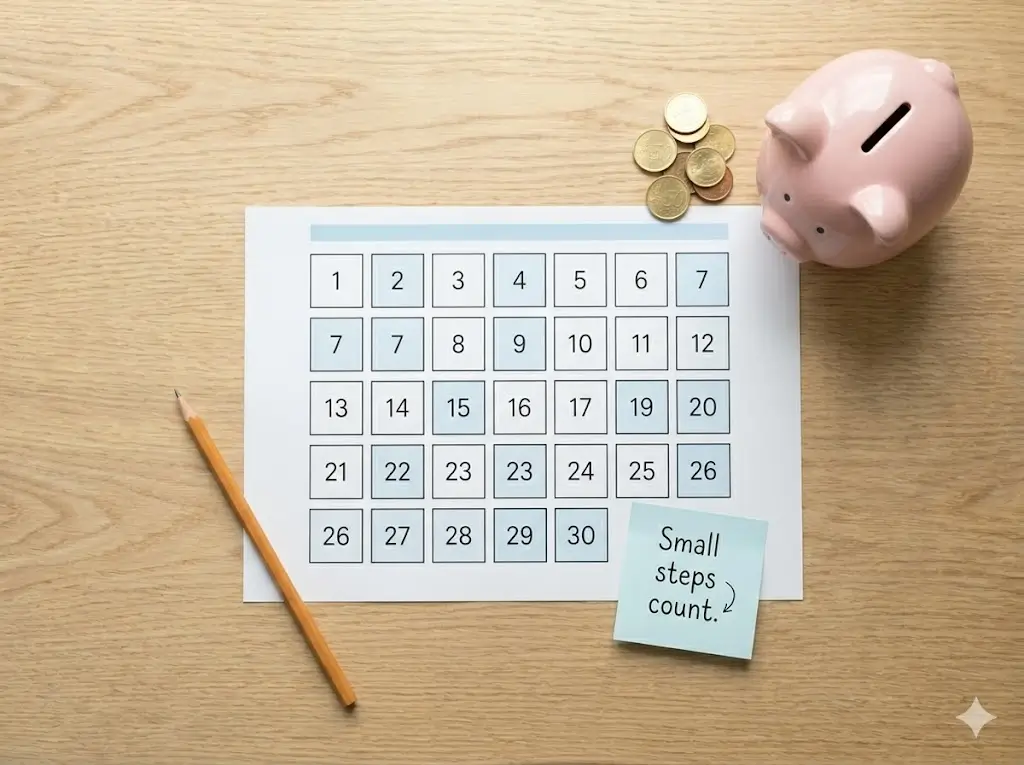
Time Investment
Unlike building passive income streams that can take months to set up, optimizing your expenses yields an immediate, guaranteed return on your time.
- Setup Time Required: 1 to 2 hours to review your past statements and establish your challenge rules.
- Daily/Weekly Time Commitment: 5 to 10 minutes a day to log expenses, plus a 20-minute weekly review.
- Timeline to First Earnings (Savings): Immediate. The first day you choose not to spend $10 on a discretionary purchase, you have generated “profit.”
- Realistic Expectations: Most beginners see a 15-25% reduction in variable expenses within 30 to 60 days of consistent effort. This saved capital can then be deployed into your first side hustle.
Step-by-Step Implementation Guide
Follow these actionable steps to execute your monthly money saving challenge successfully.
Step 1: Establish Your Spending Baseline
Before you can cut costs, you must know where your money is going. Review your last 30 days of transactions. Categorize your spending into “Fixed Needs” (rent, insurance) and “Variable Wants” (dining out, entertainment).
- Pro Tip: Highlight every recurring subscription. If you haven’t used it in two weeks, cancel it immediately. This is the fastest way to boost your income potential.
Step 2: Choose Your Monthly “No-Spend” Category
Instead of trying to cut everything at once—which leads to burnout—pick one specific variable category to eliminate for the next 30 days. Common targets include takeout coffee, restaurant delivery, or online clothing shopping.
- Insider Trick: Delete the saved credit card information from your browser and remove shopping apps from your phone to add friction to the buying process.
Step 3: Implement the Daily “Sweep”
At the end of every day, check your bank balance. Take any odd numbers and transfer them to your savings account. For example, if your checking balance is $1,245.75, transfer the $5.75 to savings.
- Pro Tip: While it seems small, this micro-saving strategy builds the psychological habit of paying yourself first, a critical mindset for future online earnings.
Step 4: Negotiate One Fixed Bill
Dedicate one hour this month to call a service provider (internet, phone, or car insurance). Inform them you are auditing your expenses and ask for their retention department to secure a lower rate.
- Insider Trick: Always research competitor rates before calling. Mentioning a specific lower price from a competitor dramatically increases your chances of getting a discount.
Step 5: Redirect the Savings into an “Opportunity Fund”
At the end of the month, calculate exactly how much you saved by avoiding your “no-spend” category and negotiating your bills. Immediately transfer this lump sum into your separate HYSA. This becomes the seed money for your monetization strategies.
Income Potential & Earnings Breakdown
When you reduce your expenses, the money you save is post-tax money. Earning an extra $100 requires paying taxes; saving $100 means keeping the full $100. Here is a realistic projection of what you can achieve during a 30-day challenge:
| Savings Action | Estimated Monthly Retained Income | Annual “Tax-Free” Equivalent |
|---|---|---|
| Canceling 2 Subscriptions | $25 – $40 | $300 – $480 |
| No-Spend Category (e.g., Dining Out) | $150 – $300 | $1,800 – $3,600 |
| Bill Negotiation (e.g., Internet/Phone) | $20 – $50 | $240 – $600 |
| Daily Balance Sweeps | $30 – $50 | $360 – $600 |
| Total Projected Monthly “Profit” | $225 – $440 | **$2,700 – $5,280** |
Disclaimer: Earnings and savings potential vary widely based on your starting income, geographical location, and current spending habits.
Alternative Methods & Variations
If a strict category elimination doesn’t fit your lifestyle, try these variations of the monthly money saving challenge:
- The 52-Week Monthly Hybrid: Save $1 the first week, $2 the second week, and so on. For a monthly variation, try saving $50 in week one, $100 in week two, etc., accelerating as you find more creative ways to cut costs.
- The Cash-Only Envelope System: Withdraw your monthly variable budget in cash. Divide it into envelopes for groceries, gas, and fun. When the envelope is empty, you stop spending.
- The “Side Hustle Match” Challenge: For every dollar you spend on a “want” (like a movie ticket), you must earn one extra dollar through a gig economy app or online earnings before you are allowed to make the purchase.
Best Practices & Optimization Tips
To maximize your revenue streams from this challenge, keep these optimization strategies in mind:
- Automate Your Success: Set up automatic transfers to your savings account on the exact day your paycheck clears. Treat your savings goal as a non-negotiable monthly bill.
- Gamify the Process: Track your progress visually on your fridge or a whiteboard. Checking off successful days triggers a dopamine hit that keeps you motivated.
- Leverage Cashback: For the items you must buy (like groceries), use cashback apps or browser extensions. Route all cashback directly into your opportunity fund.
Common Mistakes to Avoid
Many beginners fail their savings challenges within the first two weeks. Avoid these critical pitfalls:
- Extreme Deprivation: Cutting all entertainment, dining, and hobbies at once is a recipe for disaster. Studies show that over-restrictive budgeting leads to “rebound spending,” much like a crash diet. Leave a small, guilt-free allowance in your budget.
- Forgetting to Move the Money: If you skip a $5 coffee but leave that $5 in your checking account, you will inevitably spend it on something else. You must physically transfer the unspent money to a savings account to capture the “profit.”
- Not Having a “Why”: Saving just to save is boring. You need a compelling reason. Whether it is funding a new work from home business or buying peace of mind, define exactly what this capital will be used for.
Long-Term Sustainability & Growth
Completing a 30-day challenge is a great start, but true wealth is built over years.
- Reinvestment Strategies: Once you have a 3-month emergency fund, take your monthly savings and funnel them into income-producing assets. This could mean investing in index funds or using the capital to run ads for a digital income project.
- Diversification: Don’t rely solely on cutting costs. Eventually, there is a floor to how much you can save, but there is no ceiling to how much you can earn. Transition from saving mode to earning mode by starting a scalable side hustle.
- Future-Proofing: Conduct a mini-version of this monthly money saving challenge every quarter. Lifestyle creep happens to everyone; regular audits ensure your personal profit margins stay healthy.
Conclusion
Mastering a monthly money saving challenge is about much more than clipping coupons; it is about taking control of your financial destiny. By tracking your spending, eliminating waste, and treating your savings like revenue, you can generate the seed capital required to unlock true financial freedom and fund your future endeavors.
Ready to start your journey? What category are you giving up for the next 30 days? Drop your answers and questions in the comments below! Don’t forget to subscribe for weekly monetization strategies, and share your progress in our community.
FAQs
How much money can I realistically make or save with this challenge?
Depending on your starting budget, most beginners can realistically free up $200 to $500 in their first month by eliminating a discretionary category and auditing subscriptions.
Do I need prior experience with budgeting?
necessary. This challenge relies on simple subtraction and basic self-awareness. Starting with pen and paper or a free mobile app is perfectly fine.
What’s the initial investment to start this challenge?
Zero. This method requires no financial investment. You are simply reallocating money you already have.
How long until I see results?
You will see tangible results at the end of your first week when you transfer your unspent variable funds into your savings account.
Yes. In fact, during
Is this method still working in today’s economy?periods of inflation, optimizing your personal profit margins through active expense management is one of the most reliable ways to secure financial stability.
What are the risks involved?
The primary risk is “budget burnout,” which occurs if you restrict your spending too severely. To mitigate this, focus on cutting costs on things you don’t care about, so you can still afford modest spending on the things you love.
Before you go, tap those stars!
Straightforward, no gimmicks, just solid banking advice
I clicked on this article expecting it to push some specific bank or financial product with referral links. I was pleasantly surprised. The advice was unbiased, focused on principles rather than promoting any particular institution, and gave me a clear framework to evaluate my own options. I appreciated that the article addressed the importance of FDIC insurance, automatic transfers, and goal-setting — things that seem obvious but that most people (including me) overlook. The writing was clear and concise, without the usual fluff or overly complex financial jargon. The only reason I’m giving four stars instead of five is that I would have liked even more detail on how to balance saving with paying down debt. Still, this was one of the most practical and trustworthy articles on saving I’ve read in a long time. Highly recommend.
Solid advice that cuts through the noise
I’ve been saving for years, but I kept wondering if my money was actually working as hard as it could be. There’s so much conflicting information out there — regular savings accounts, money market accounts, CDs, high-yield options — it gets confusing fast. This article did an excellent job comparing the options side by side, explaining the pros and cons of each, and helping me figure out which strategy made sense for my situation. I especially appreciated the section on the importance of emergency funds versus long-term savings, and the breakdown of how compound interest really adds up over time. I ended up moving my savings to a high-yield account and setting clearer goals. Practical, well-researched, and genuinely helpful.
Small changes, noticeable results
I’ll be honest — I clicked on this article expecting generic advice like “drive less” (thanks, captain obvious). But I was genuinely impressed. The article breaks down the actual science behind why certain habits affect fuel economy, with real numbers to back it up. I learned that my lead-foot acceleration and speeding were costing me way more than I realized. The section on vehicle maintenance was especially valuable — I didn’t know a dirty air filter could impact mileage that much. The tone was straightforward, no fluff, no upselling expensive products. Just solid, practical advice that actually works. My fuel expenses dropped by about 15% last month without me changing my overall driving needs.
Finally, practical advice that doesn’t require buying a new car
As someone who drives over 400 miles a week for work, gas expenses have been crushing my budget. I’ve read countless articles that basically just say “buy an electric vehicle” — which isn’t helpful when that’s not in my budget. This article was a game-changer. The tips were immediately actionable: combining trips, checking tire pressure (I didn’t realize how much that affects mileage!), and using gas price apps. I started implementing these suggestions last month, and I’ve already saved about $40. The writing was clear, well-organized, and respected that not everyone can just trade in their car. Highly recommend for anyone feeling the pain at the pump.
Perfect for renters who can’t install solar panels
As someone who rents an apartment, I often feel limited when it comes to making my home more energy-efficient. I can’t just install new appliances or add insulation to the walls. This article was a lifesaver because it focused on renter-friendly solutions—things like weatherstripping for doors, smart power strips, and optimizing how I use my existing appliances. The writing was straightforward and didn’t assume I owned a home. My only small critique is that I would have loved even more rent-specific examples, but overall, this was incredibly helpful. My electric bill dropped by about $15 last month!