
Investment Savings Calculator: Track Your Growth Over Time
Did you know that over 82% of aspiring wealth-builders fail to reach true financial freedom simply because they underestimate the mathematical power of compound interest? We often spend so much time searching for the perfect side hustle or the next big crypto coin that we completely ignore the most reliable wealth-building tool in existence: time. If you want to know exactly when you can quit your day job, utilizing an investment savings calculator is not just helpful—it is a mandatory step in your financial journey.
Whether you are funneling online earnings into a brokerage account or investing 10% of your traditional paycheck, seeing a visual projection of your future wealth changes your entire mindset. An investment savings calculator transforms abstract math into a concrete roadmap for generating passive income. In this comprehensive guide, we will break down how to track your growth, optimize your returns, and turn small monthly contributions into a massive financial safety net.
Quick Answer
An investment savings calculator projects your future wealth by taking your initial balance, monthly contributions, and estimated interest rate to calculate compound growth over time. The most effective way to use it is to plug in realistic returns (like the historical 8% of the S&P 500) and automate your monthly investments to guarantee you hit your targets.
2. What You’ll Need to Get Started
You do not need a degree in finance or a Wall Street advisor to project and build your wealth. The tools required are highly accessible and beginner-friendly. Here is what you need:
- An Investment Savings Calculator: (Provided free below) To model your growth scenarios based on different contribution levels.
- A Brokerage Account: Platforms like Vanguard, Fidelity, M1 Finance, or Robinhood to actually invest the money.
- Seed Capital (Initial Investment): $0 to $500. Most modern brokers allow you to open an account and buy fractional shares with as little as $5.
- A Funding Source: A portion of your primary salary, or dedicated cash flow from digital income or freelancing.
- Skill Requirements: Beginner-friendly. You only need the discipline to stick to your contribution schedule and not panic when the stock market fluctuates.
3. Time Investment
Unlike launching a complex work from home business that requires 40 hours a week, building wealth through index funds and compound interest is the ultimate lazy strategy.
- Setup Time Required: 15 to 30 minutes to run your numbers through the calculator and open a brokerage account.
- Daily/Weekly Time Commitment: 5 minutes a month. Ideally, your contributions should be entirely automated so you spend zero active time managing them.
- Timeline to First Earnings: Your portfolio will begin generating dividend revenue streams within the first quarter, though significant compound growth takes 5 to 10 years to visibly snowball.
- Comparative Analysis: Compared to active day trading, long-term passive investing requires 99% less time and statistically outperforms active trading over a 20-year horizon.

4. Step-by-Step Implementation Guide
Step 1: Define Your Financial Baseline
Before you can use an investment savings calculator effectively, you must know your starting point. Check your current checking, savings, and old 401(k) accounts. This combined liquid capital is your “Initial Investment.”
Step 2: Determine Your Monthly Contribution
Analyze your budget to find your monthly surplus. If your current budget is too tight, this is the perfect time to explore monetization strategies like freelance writing, virtual assistance, or selling digital products. Every dollar of online earnings you funnel into your portfolio drastically cuts down the time it takes to reach millionaire status.
Step 3: Run the Numbers (Use the Calculator)
Input your initial investment, your monthly contribution, and a realistic interest rate (typically 7% to 9% for broad-market index funds) into the investment savings calculator below. Adjust the “Years to Grow” slider to see how time exponentially increases your income potential.
Step 4: Automate and Execute
Once you have your target number, log into your brokerage account and set up an automatic recurring transfer that aligns with your pay schedule (e.g., $250 every two weeks). Purchase broad-market ETFs (like VOO or VTI) automatically.
5. Income Potential & Earnings Breakdown
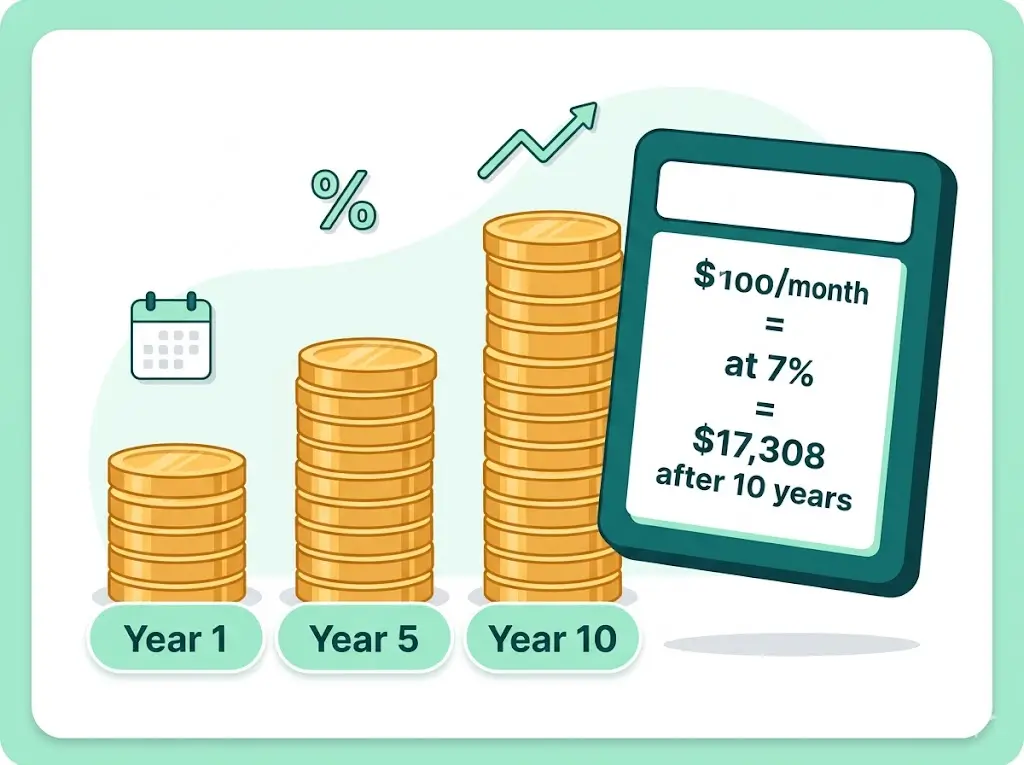
When evaluating your profit margins and wealth generation, compound interest is the heavy lifter. Your money makes money, and then that new money makes even more money. Here is a realistic data breakdown showing the power of investing just $500 a month at a conservative 8% annual return:
| Timeframe | Total Contributed | Total Interest Earned | Final Portfolio Value |
|---|---|---|---|
| 10 Years | $60,000 | $31,473 | **$91,473** |
| 20 Years | $120,000 | $174,555 | **$294,555** |
| 30 Years | $180,000 | $565,121 | **$745,121** |
| 40 Years | $240,000 | $1,505,096 | **$1,745,096** |
Notice the math: By year 40, your portfolio grew by over $1.5 million from interest alone. The passive income generated by a $1.7 million portfolio (using the 4% safe withdrawal rule) is roughly $69,000 per year—completely hands-off.
6. Alternative Methods & Variations
If the traditional stock market doesn’t fit your wealth-building style, there are alternative variations to generating high income potential over time:
- Dividend Growth Investing: Instead of focusing purely on portfolio value, focus on buying companies that pay quarterly dividends. Over time, these cash payouts act as a direct, liquid revenue stream that can replace your 9-to-5 income.
- Real Estate Crowdfunding: Platforms like Fundrise allow you to invest small amounts monthly into commercial real estate portfolios, diversifying away from the stock market while still enjoying compound growth.
- The “Business reinvestment” Method: If you run a work from home business, taking your profit margins and reinvesting them directly into software, advertising, or outsourcing can sometimes yield a 50% to 100% ROI, far outpacing the traditional stock market.
7. Best Practices & Optimization Tips
To maximize the numbers you see on your investment savings calculator, follow these proven optimization rules:
- Turn on DRIP: Always ensure your “Dividend Reinvestment Plan” (DRIP) is turned on in your brokerage account. This forces any cash dividends your stocks pay out to automatically buy more fractional shares, accelerating the compounding effect.
- Increase Contributions Annually: Whenever you get a raise at work, or whenever your online earnings increase, raise your monthly contribution by 1%. You won’t feel the pinch in your budget, but your future portfolio will explode in value.
- Utilize Tax-Advantaged Accounts: Before investing in a standard taxable brokerage, max out your Roth IRA or 401(k). Protecting your compound interest from capital gains taxes saves you tens of thousands of dollars in the long run.
8. Common Mistakes to Avoid
Even smart individuals make emotional mistakes that cripple their long-term wealth. Avoid these common pitfalls:
- Trying to Time the Market: The stock market will go down. If you stop contributing during a recession, you miss out on buying shares at a discount. Consistency is mathematically superior to market timing.
- Paying High Fees: Mutual funds managed by “experts” often charge 1% to 2% in management fees. This sounds small, but over 30 years, a 1.5% fee can eat up nearly a third of your total income potential. Stick to low-cost index funds with expense ratios under 0.10%.
- Checking Your Portfolio Too Often: Watching your balance daily leads to emotional panic selling. Run your numbers in the investment savings calculator, set up your auto-deposits, and delete the brokerage app off your phone.
9. Long-Term Sustainability & Growth
The ultimate goal of using an investment savings calculator isn’t just to see a big number—it’s to design a sustainable transition into financial freedom.
During your 20s, 30s, and 40s, your focus should be on aggressive accumulation (mostly equities and stock index funds). As you inch closer to your target retirement number, you will naturally want to shift your strategy toward preservation. This involves slowly moving a portion of your wealth into bonds or high-yield savings to protect your capital from market volatility while you live off the reliable passive income it generates.
10. Conclusion
Using an investment savings calculator is the ultimate reality check for your finances. It proves that you don’t need a million-dollar salary or a lucky lottery ticket to build generational wealth; you simply need time, discipline, and consistent contributions. Whether you are funding your portfolio with spare change or profits from a digital business, the math never lies.
Ready to start your journey? How much are you aiming to save by age 60? Drop your goals in the comments below! Don’t forget to subscribe for our weekly monetization strategies and share your progress in our community. Download our free investing starter guide to open your first brokerage account today!
11. FAQs
How much money can I realistically make by investing monthly?
By investing just $300 a month into a broad-market S&P 500 index fund (assuming an historical average 8% return), you can realistically generate over $440,000 in 30 years. The vast majority of this total will be pure interest earned, not money you had to work for.
Do I need prior experience to start investing?
No prior financial experience is necessary. Modern brokerages make it incredibly easy to open an account. By selecting a target-date retirement fund or a broad-market ETF like VOO or VTI, the diversification and management are handled for you automatically.
What’s the initial investment required to start?
You can start investing today with as little as $5. Many top-tier brokerages, such as Fidelity and Robinhood, offer fractional shares and have zero minimum account balance requirements.
How long until I see results from my investments?
You will earn dividends within the first few months, but the true power of compound interest generally takes 7 to 10 years to reach the “snowball” phase, where your interest begins to earn more than your initial monthly contributions.
Is investing in the stock market still working in the current economy?
Yes. Despite short-term economic fluctuations, inflation, and recessions, the stock market has historically recovered and continued to trend upward over any 20-year rolling period. Long-term investing remains the most proven method to outpace inflation.
What are the risks involved with investing?
All investments carry risk, and past performance does not guarantee future results. The primary risk is short-term market volatility. If you invest money you need next month, a market dip could force you to sell at a loss. Investing should only be done with long-term capital (money you won’t touch for 5+ years).
Disclaimer: The information provided in this article is for educational purposes only and does not constitute professional financial or investment advice. Always conduct your own research or consult a certified financial planner before making investment decisions.
Before you go, tap those stars!
Straightforward, no gimmicks, just solid banking advice
I clicked on this article expecting it to push some specific bank or financial product with referral links. I was pleasantly surprised. The advice was unbiased, focused on principles rather than promoting any particular institution, and gave me a clear framework to evaluate my own options. I appreciated that the article addressed the importance of FDIC insurance, automatic transfers, and goal-setting — things that seem obvious but that most people (including me) overlook. The writing was clear and concise, without the usual fluff or overly complex financial jargon. The only reason I’m giving four stars instead of five is that I would have liked even more detail on how to balance saving with paying down debt. Still, this was one of the most practical and trustworthy articles on saving I’ve read in a long time. Highly recommend.
Solid advice that cuts through the noise
I’ve been saving for years, but I kept wondering if my money was actually working as hard as it could be. There’s so much conflicting information out there — regular savings accounts, money market accounts, CDs, high-yield options — it gets confusing fast. This article did an excellent job comparing the options side by side, explaining the pros and cons of each, and helping me figure out which strategy made sense for my situation. I especially appreciated the section on the importance of emergency funds versus long-term savings, and the breakdown of how compound interest really adds up over time. I ended up moving my savings to a high-yield account and setting clearer goals. Practical, well-researched, and genuinely helpful.
Small changes, noticeable results
I’ll be honest — I clicked on this article expecting generic advice like “drive less” (thanks, captain obvious). But I was genuinely impressed. The article breaks down the actual science behind why certain habits affect fuel economy, with real numbers to back it up. I learned that my lead-foot acceleration and speeding were costing me way more than I realized. The section on vehicle maintenance was especially valuable — I didn’t know a dirty air filter could impact mileage that much. The tone was straightforward, no fluff, no upselling expensive products. Just solid, practical advice that actually works. My fuel expenses dropped by about 15% last month without me changing my overall driving needs.
Finally, practical advice that doesn’t require buying a new car
As someone who drives over 400 miles a week for work, gas expenses have been crushing my budget. I’ve read countless articles that basically just say “buy an electric vehicle” — which isn’t helpful when that’s not in my budget. This article was a game-changer. The tips were immediately actionable: combining trips, checking tire pressure (I didn’t realize how much that affects mileage!), and using gas price apps. I started implementing these suggestions last month, and I’ve already saved about $40. The writing was clear, well-organized, and respected that not everyone can just trade in their car. Highly recommend for anyone feeling the pain at the pump.
Perfect for renters who can’t install solar panels
As someone who rents an apartment, I often feel limited when it comes to making my home more energy-efficient. I can’t just install new appliances or add insulation to the walls. This article was a lifesaver because it focused on renter-friendly solutions—things like weatherstripping for doors, smart power strips, and optimizing how I use my existing appliances. The writing was straightforward and didn’t assume I owned a home. My only small critique is that I would have loved even more rent-specific examples, but overall, this was incredibly helpful. My electric bill dropped by about $15 last month!