
How to Start a Saving Money Bullet Journal: A Simple Guide
Did you know that nearly 78% of aspiring entrepreneurs fail to build sustainable online earnings simply because they lack the initial capital to get started? They dream of a work from home lifestyle but completely ignore the “leaks” in their current daily spending. If you want to achieve true financial freedom, you must first master the art of retaining the money you already make.
This is where a saving money bullet journal becomes your ultimate financial weapon. Unlike complex apps or intimidating spreadsheets, a bullet journal offers a tactile, customizable, and mindful approach to tracking your expenses. It forces you to slow down and acknowledge every dollar spent.
In this comprehensive guide, we will show you exactly how to start a saving money bullet journal from scratch, helping you plug your budget leaks and build the capital needed to finally launch your dream side hustle.
What You’ll Need to Get Started
You do not need an art degree or an expensive setup to create a highly effective saving money bullet journal. Here are the required tools and resources to begin:
- A Dotted Notebook: A standard A5 dotted journal (like a Leuchtturm1917 or a generic Amazon alternative) works best for drawing straight lines and charts.
- Quality Pens: A basic black fineliner (e.g., Sakura Pigma Micron) for outlines and a reliable writing pen.
- A Ruler: Essential for creating clean, scannable grids and tracking tables.
- Highlighters/Markers (Optional): Mildliners or colored pencils to color-code different expense categories (e.g., red for needs, green for wants).
- Initial Investment: $10 to $30 maximum.
- Skill Requirements: Basic addition and subtraction. No artistic skills are required—minimalism often works best for financial tracking!
Pro Tip: For a zero-cost alternative, you can use any lined notebook you already have laying around the house.
Time Investment
Building a visual tracking system takes a bit of upfront effort, but it pays massive dividends in your financial awareness. Here is the realistic time commitment:
- Setup Time Required: 45 to 60 minutes to design your initial monthly spreads and savings trackers.
- Daily Time Commitment: 3-5 minutes at the end of each day to log your expenses and shade in your visual trackers.
- Weekly Time Commitment: 15 minutes every Sunday to tally your spending and review your budget.
- Timeline to First Results: Most beginners see a radical shift in their spending habits and tangible bank account growth within 60-90 days of consistent tracking.
- Compared to Traditional Income: Trying to build new revenue streams from scratch can take months to yield profits. Conversely, identifying a $50 phantom subscription in your bullet journal puts cash back into your pocket today.
Step-by-Step Implementation Guide
Follow these actionable steps to set up your saving money bullet journal for maximum effectiveness and minimal overwhelm.
Step 1: Define Your Financial “Why”
Before drawing a single line, dedicate your first page to your overarching goal. Are you saving $1,000 for an emergency fund? Are you trying to build a $500 runway to fund your new digital income project? Write this goal in bold letters. This is your motivation page.
Step 2: Create Your Monthly Budget Spread
Dedicate a two-page spread to your current month.
- Left Page (Income & Fixed Expenses): List your expected income. Below it, list all fixed bills (rent, insurance, internet).
- Right Page (Variable Expenses): Create categories for groceries, dining out, entertainment, and gas. Assign a strict budget to each.
Step 3: Design a Visual Savings Tracker
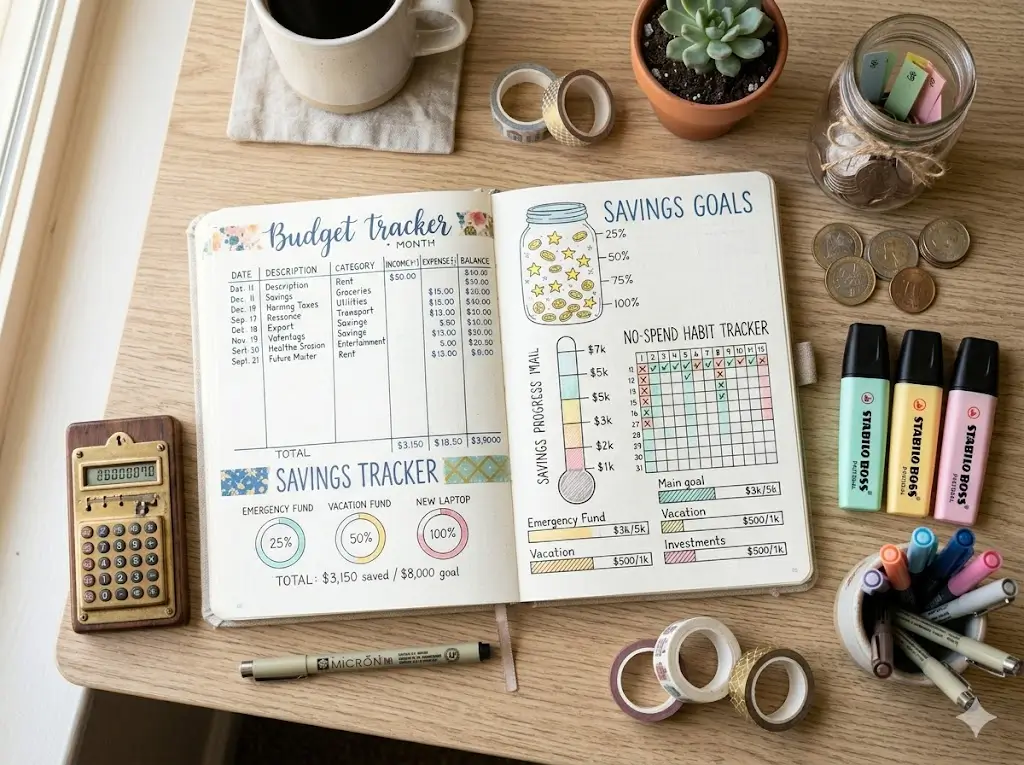
Visuals are the secret sauce of a bullet journal. Draw a shape relevant to your goal (e.g., a thermometer, a jar, or a simple grid of 100 squares). If your goal is to save $1,000, and you draw 100 squares, each square represents $10. Every time you transfer $10 to savings, color in a square.
Step 4: The Daily Expense Log
Turn to the next blank page and create a simple table with four columns: Date, Item, Category, Amount. Every evening, review your bank app and write down exactly what you spent that day. The physical act of writing suppresses future impulse buys.
Step 5: The End-of-Month Review
At the end of the month, tally up your categories. Did you overspend on dining out? Did you hit your savings goal? Write down a brief reflection on what went well and what needs adjustment for the following month.

Income Potential & Earnings Breakdown
When you aggressively track your money, you widen your personal profit margins. Every dollar saved is a tax-free dollar earned. Here is a realistic breakdown of what a saving money bullet journal can help you uncover:
| Spending Category Optimized | Estimated Monthly Savings | 1-Year Capital Created | Potential Reinvestment |
|---|---|---|---|
| Cutting Unused Subscriptions | $30 – $60 | $360 – $720 | Website hosting / Domain |
| Reducing Dining Out by 50% | $150 – $300 | $1,800 – $3,600 | Side hustle inventory |
| Halting Impulse Purchases | $100 – $200 | $1,200 – $2,400 | High-yield dividend stocks |
| Total Potential Capital: | $280 – $560/mo | **$3,360 – $6,720/year** | Your wealth foundation! |
Disclaimer: Results vary based on individual spending habits and geographic location. The figures above are estimates based on average consumer budget corrections.
Alternative Methods & Variations
If a traditional pen-and-paper saving money bullet journal doesn’t fit your lifestyle, consider these highly effective variations:
- The Digital Bullet Journal: Use a tablet with a stylus (like an iPad with GoodNotes or Procreate) to get the tactile feel of writing without carrying a physical book.
- The Notion Financial Dashboard: For those who prefer typing, Notion offers incredible customizable templates that mimic the bullet journal methodology but allow for automated math.
- The Minimalist Pocket Log: Instead of a large A5 notebook, carry a tiny pocket notebook. Only log discretionary spending (coffee, snacks, clothes) to target your worst habit areas.
- The Pre-made Planner: If drawing grids stresses you out, purchase a pre-made financial planner (like the Clever Fox Budget Planner) that provides the structure for you.
Best Practices & Optimization Tips
To guarantee long-term success with your journal, implement these expert strategies:
- Practice Habit Stacking: Tie your daily logging to an existing habit. For example, update your expense log every morning while you drink your first cup of coffee.
- Keep It Forgiving: If you forget to log your expenses for three days, don’t abandon the journal. Just pull up your bank app, backfill the data, and keep moving.
- Use the “No-Spend” Challenge: Dedicate one page to a calendar and mark an “X” on every day you spend zero dollars on non-essentials. Gamifying the process dramatically increases your income potential via savings.
- Find Community Inspiration: Search Pinterest or Instagram for “#bujofinance” or “#budgetspread” to find endless layout ideas from experienced creators.
Common Mistakes to Avoid
Even enthusiastic beginners fall into common traps. Here are the major pitfalls to avoid to ensure your journaling journey doesn’t end in frustration:
- The Perfectionism Trap: Spending three hours drawing beautiful floral borders around your budget but failing to actually write down your expenses. Function must always precede form.
- Making Too Many Categories: If you break your budget down into 30 hyper-specific categories, tracking becomes a nightmare. Stick to 8-10 broad categories.
- Forgetting Cash Transactions: Because they don’t show up on your bank app, cash expenses easily slip through the cracks. Ask for receipts and log them immediately.
- Using the Journal to Shame Yourself: Your journal is a data collection tool, not a diary of guilt. If you overspend, objectively note it and adjust your monetization strategies for next month without self-judgment.
Long-Term Sustainability & Growth
The ultimate goal of a saving money bullet journal is not just to hoard cash—it is to fund your future.
Once your journal helps you establish a solid 3-to-6-month emergency fund, you should transition your focus toward wealth building. Take the surplus cash you are tracking and begin directing it toward passive income investments, index funds, or educational courses that boost your earning power. By migrating your journal each month and consistently reinvesting your saved capital, you transition from simply surviving to actively building multi-generational wealth.
Conclusion
Taking control of your personal finances is the most critical step toward achieving true financial independence. By starting a saving money bullet journal, you force yourself to be mindful of your cash flow, drastically widening your personal profit margins. Remember, the goal isn’t just to save pennies; it’s to build the seed capital required to fund your dream life.
Ready to start your journey? Drop a comment below telling us what financial goal you are tracking first! Subscribe to our newsletter for weekly money-making strategies, and be sure to share a photo of your new journal spreads in our community forum.
FAQs
How much money can I realistically make or save with this method?
While a journal doesn’t generate new income, identifying and cutting wasteful spending typically frees up $150 to $500 a month for the average household, acting as a massive tax-free raise.
Do I need prior experience or artistic skills?
Not at all. The most effective financial bullet journals are often the simplest. A basic ruler and pen are all you need to create functional grids and lists.
What’s the initial investment?
You can start for free using a notebook you already own. If you want a dedicated dotted journal and a nice pen, expect to spend between $10 and $30.
How long until I see results?
You will gain clarity on your spending habits by the end of week one. Noticeable growth in your savings account usually compounds and becomes highly visible within 60 to 90 days.
Is this method still working in the current digital age?
Yes. In an era of one-click purchases and invisible digital transactions, the physical friction of writing down your expenses is one of the most effective ways to curb impulse shopping.
What are the risks involved?
There is zero financial risk. The only minor risk is burnout if you make your tracking layouts too complicated to maintain daily. Start simple and build complexity only if it serves you.
Before you go, tap those stars!
Straightforward, no gimmicks, just solid banking advice
I clicked on this article expecting it to push some specific bank or financial product with referral links. I was pleasantly surprised. The advice was unbiased, focused on principles rather than promoting any particular institution, and gave me a clear framework to evaluate my own options. I appreciated that the article addressed the importance of FDIC insurance, automatic transfers, and goal-setting — things that seem obvious but that most people (including me) overlook. The writing was clear and concise, without the usual fluff or overly complex financial jargon. The only reason I’m giving four stars instead of five is that I would have liked even more detail on how to balance saving with paying down debt. Still, this was one of the most practical and trustworthy articles on saving I’ve read in a long time. Highly recommend.
Solid advice that cuts through the noise
I’ve been saving for years, but I kept wondering if my money was actually working as hard as it could be. There’s so much conflicting information out there — regular savings accounts, money market accounts, CDs, high-yield options — it gets confusing fast. This article did an excellent job comparing the options side by side, explaining the pros and cons of each, and helping me figure out which strategy made sense for my situation. I especially appreciated the section on the importance of emergency funds versus long-term savings, and the breakdown of how compound interest really adds up over time. I ended up moving my savings to a high-yield account and setting clearer goals. Practical, well-researched, and genuinely helpful.
Small changes, noticeable results
I’ll be honest — I clicked on this article expecting generic advice like “drive less” (thanks, captain obvious). But I was genuinely impressed. The article breaks down the actual science behind why certain habits affect fuel economy, with real numbers to back it up. I learned that my lead-foot acceleration and speeding were costing me way more than I realized. The section on vehicle maintenance was especially valuable — I didn’t know a dirty air filter could impact mileage that much. The tone was straightforward, no fluff, no upselling expensive products. Just solid, practical advice that actually works. My fuel expenses dropped by about 15% last month without me changing my overall driving needs.
Finally, practical advice that doesn’t require buying a new car
As someone who drives over 400 miles a week for work, gas expenses have been crushing my budget. I’ve read countless articles that basically just say “buy an electric vehicle” — which isn’t helpful when that’s not in my budget. This article was a game-changer. The tips were immediately actionable: combining trips, checking tire pressure (I didn’t realize how much that affects mileage!), and using gas price apps. I started implementing these suggestions last month, and I’ve already saved about $40. The writing was clear, well-organized, and respected that not everyone can just trade in their car. Highly recommend for anyone feeling the pain at the pump.
Perfect for renters who can’t install solar panels
As someone who rents an apartment, I often feel limited when it comes to making my home more energy-efficient. I can’t just install new appliances or add insulation to the walls. This article was a lifesaver because it focused on renter-friendly solutions—things like weatherstripping for doors, smart power strips, and optimizing how I use my existing appliances. The writing was straightforward and didn’t assume I owned a home. My only small critique is that I would have loved even more rent-specific examples, but overall, this was incredibly helpful. My electric bill dropped by about $15 last month!