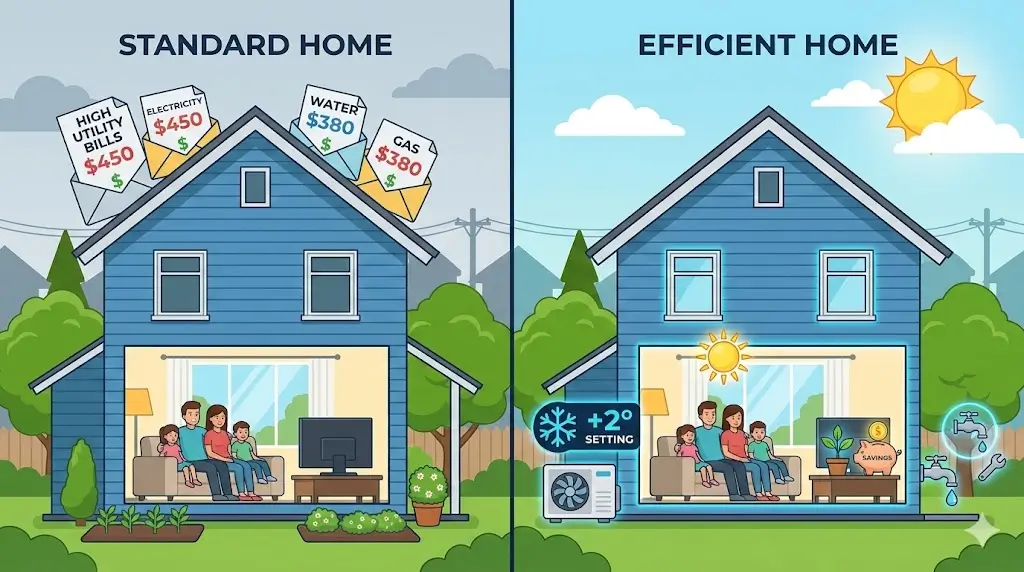
How to Lower Utility Bills Without Major Lifestyle Changes
Did you know that the average household wastes over $500 annually on energy inefficiencies—money that could otherwise be used to fund a new business or investment portfolio? When most people start searching for ways to achieve financial freedom, they immediately look for a new side hustle or ways to boost their online earnings. However, they completely ignore the massive leaks in their current cash flow.
If you want to maximize your personal profit margins, learning how to lower utility bills is the absolute fastest and most reliable place to start. Especially as more professionals transition to a work from home lifestyle, household energy consumption has skyrocketed, quietly eating away at digital income. By implementing a few strategic, set-it-and-forget-it adjustments, you can permanently lower utility bills without sacrificing your comfort or making drastic lifestyle changes. In this comprehensive guide, we will break down exactly how to reclaim this hidden capital to fuel your broader wealth-building strategies.
What You’ll Need to Get Started
Optimizing your household energy consumption requires minimal upfront investment. In fact, many of the most effective strategies are entirely free. Here are the tools and resources you’ll need to successfully lower utility bills:
- Your Latest Utility Statements: Gather your electricity, water, and gas bills from the last 3-6 months to establish a baseline.
- Smart Power Strips / Plugs: Essential for combating “phantom energy” drain.
- Estimated Cost: $15 – $30 (Often pays for itself within 2-3 months).
- Weather-Stripping and Caulk: Basic draft-proofing materials to seal windows and doors.
- Estimated Cost: $10 – $20.
- A Programmable or Smart Thermostat (Optional but recommended): * Free Alternative: Manually adjusting your standard thermostat using a sticky note reminder.
- Initial Investment: $0 to $50 total. (This process generates retained capital immediately).
Time Investment and Expectations
Unlike building complex monetization strategies from scratch, optimizing your home’s energy efficiency requires a very small time commitment for an immediate payout.
- Setup Time Required: 2 to 3 hours on a weekend to perform a home energy audit, apply weather-stripping, and configure your thermostat and smart plugs.
- Daily/Weekly Time Commitment: 0 minutes. Once set up, the savings are entirely automated.
- Timeline to First Earnings (Savings): Most beginners see a noticeable drop in their overhead within 30 to 60 days (usually the very next billing cycle).
- Comparison with Traditional Income: Earning an extra $50 a month from a side hustle requires continuous labor and is subject to income tax. Saving $50 a month on utilities is passive, tax-free, and requires zero ongoing effort.
Step-by-Step Implementation Guide
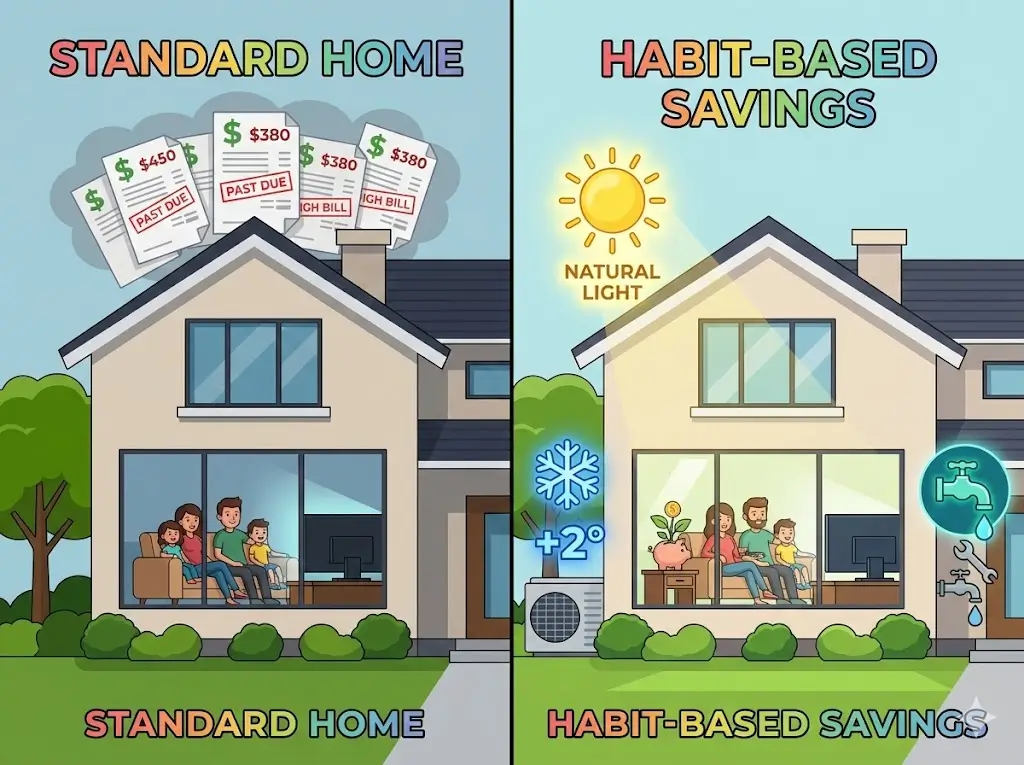
Follow these sequential, beginner-friendly steps to permanently lower utility bills and increase your household’s monthly cash flow.
Step 1: Perform a DIY Home Energy Audit
Before buying anything, figure out where your energy is escaping. Walk through your home on a windy day and run your hand along window frames and door seams. If you feel a draft, that is your hard-earned money leaking out.
- Insider Trick: Contact your local energy provider. Many utility companies offer free professional home energy audits and will even give you free LED bulbs or smart thermostats just for participating.
Step 2: Slay “Phantom” Power Drain
Did you know that plugged-in electronics consume power even when turned off? This is called phantom energy and accounts for up to 10% of your monthly electric bill.
- Actionable Step: Plug your entertainment centers (TV, soundbars, gaming consoles) and home office equipment (monitors, printers) into smart power strips. With one click, you can cut power to the entire strip when not in use.
Step 3: Optimize the “Thermostat Dead Zone”
Heating and cooling make up nearly 50% of the average utility bill. You can lower utility bills significantly without feeling cold or hot by implementing a “dead zone.”
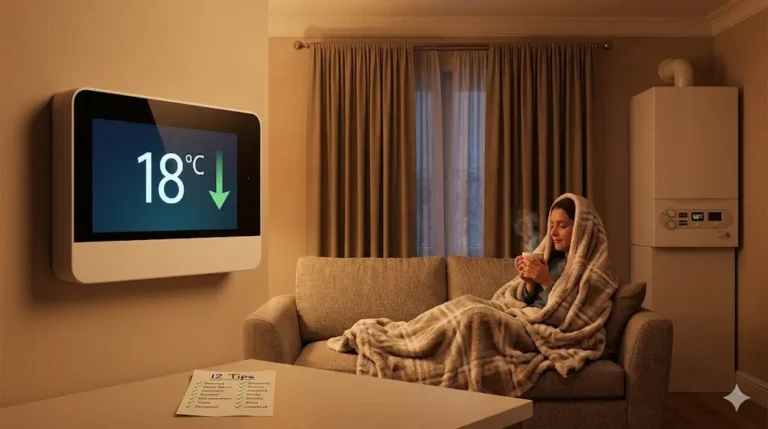
- Pro Tip: Set your thermostat 2-3 degrees higher in the summer and 2-3 degrees lower in the winter. Your body will adjust to the slight change within a few days, but your wallet will notice a massive difference at the end of the month.
Step 4: Lower Your Water Heater Temperature
By default, most manufacturers set water heaters to 140°F (60°C). This is not only a scalding hazard but a massive waste of energy.
- Actionable Step: Turn the dial on your water heater down to 120°F. You will still have plenty of hot water for showers and dishwashing, but your heating costs will drop by roughly 10% annually.

Income Potential & Earnings Breakdown
When you lower utility bills, you are engaging in one of the most efficient forms of wealth generation: expense optimization. Because every dollar saved is a post-tax dollar, the “income potential” of frugality is mathematically superior to earning more money.
Here is a realistic breakdown of what you can “earn” back into your budget by optimizing your utilities:
- Beginner (Basic Optimizations): Savings of $30 – $50/month.
- Equivalent Pre-Tax Side Hustle Earning Needed: ~$55 – $75/month.
- Intermediate (Draft-proofing & Smart Tech): Savings of $60 – $100/month.
- Equivalent Pre-Tax Side Hustle Earning Needed: ~$90 – $145/month.
- Advanced (Solar incentives, high-efficiency upgrades): Savings of $150+/month.
- Annual Retained Capital: $1,800+ (which can be fully reinvested into revenue streams).
Alternative Methods & Variations
Depending on your living situation, there are different approaches to the same goal of reducing household overhead:
- For Renters: Since you cannot install new windows or insulation, focus entirely on plug-load management, using heavy blackout curtains for insulation, and requesting the landlord fix broken weather-stripping.
- The “Time-of-Use” Variation: Many utility companies offer lower rates during off-peak hours (e.g., 9 PM to 6 AM). Shift heavy energy tasks like laundry and running the dishwasher to these hours to slash costs without using less total energy.
- Community Solar Programs: If you cannot install solar panels on your own roof, look into community solar sharing. This allows you to subscribe to a local solar farm and receive credits on your utility bill, requiring zero upfront investment.
Best Practices & Optimization Tips
To truly maximize your savings and integrate these habits into your broader financial strategy, keep these best practices in mind:
- Automate the Difference: If your utility bill drops from $150 to $100, do not accidentally spend that $50 on takeout. Set up an automatic monthly transfer of $50 into an investment account or use it to fund the startup costs of a digital business.
- Use Appliance Timers: Put your Wi-Fi router, decorative lights, and non-essential electronics on cheap mechanical timers so they turn off automatically while you sleep.
- Regular HVAC Maintenance: A dirty air filter forces your HVAC system to work 15% harder. Change your filters every 60-90 days to maintain peak efficiency.
Common Mistakes to Avoid
When trying to lower utility bills, it is easy to fall into traps that actually end up costing you more money. Avoid these costly pitfalls:
- Mistake 1: Turning the AC Completely Off When You Leave. It takes significantly more energy to cool a house from 85°F back down to 72°F than it does to maintain a steady 78°F while you are at work. Prevention: Use programmable setbacks, not hard shutoffs.
- Mistake 2: Buying Expensive “Green” Gadgets Unnecessarily. Spending $3,000 on brand-new, energy-efficient windows to save $5 a month is a terrible return on investment. Prevention: Always calculate the payback period before making major purchases. Stick to cheap, high-ROI fixes first.
- Mistake 3: Ignoring Water Leaks. A seemingly harmless dripping faucet or a running toilet can waste thousands of gallons of water a month, leading to a shocking water bill. Prevention: Add a drop of food coloring to your toilet tank; if it bleeds into the bowl without flushing, you have a leak.
Long-Term Sustainability & Growth
The goal of learning how to lower utility bills isn’t just to save a few dollars this month; it is about creating a sustainable financial ecosystem. By permanently reducing your monthly baseline overhead, you create long-term stability and growth potential.
The most successful entrepreneurs take the money they recover from utility savings and direct it toward purchasing cash-flowing assets. Over time, that $75 a month saved on electricity and water can be invested into dividend stocks, real estate crowdfunding, or funding online ads for a digital product. You are effectively using your utility company’s money to build your own passive income empire.
Conclusion
Learning how to lower utility bills without major lifestyle changes is the smartest first step on the road to financial freedom. By tackling phantom power, optimizing your thermostat, and conducting a simple energy audit, you instantly increase your household profit margins. This isn’t about sitting in the dark or taking freezing showers; it’s about eliminating waste so you can redirect your hard-earned money toward your true financial goals.
Ready to start your journey? Drop your biggest utility bill struggle in the comments below! Don’t forget to subscribe for weekly money-making strategies, and share your progress in our community of savvy optimizers!
Frequently Asked Questions (FAQs)
How much money can I realistically make or save by optimizing utilities?
While actual amounts vary by home size and location, the average household can reliably cut 15% to 25% off their energy bills by addressing phantom power, draft-proofing, and thermostat optimization. This often translates to $500 to $1,000 in retained capital per year.
Do I need prior experience to perform a home energy audit?
No, a basic DIY home energy audit requires zero experience. You simply need to look for drafts around doors and windows, identify older incandescent light bulbs, and locate electronics that remain plugged in 24/7. Your utility company may also offer free professional audits.
What’s the initial investment to start lowering my bills?
The initial investment is incredibly low. You can start for free by adjusting your water heater and thermostat. Spending $20 to $50 on smart power strips and basic weather-stripping is highly recommended for maximizing results.
How long until I see results?
You will see results in your very next billing cycle. If you implement these changes at the beginning of the month, your subsequent utility bill will immediately reflect your optimizations, making this a highly rewarding process.
Is this method still working in 2026?
Yes, and it is more important than ever. With global energy costs continuing to fluctuate and the rise of remote work increasing home energy usage, proactively lowering your utility bills is a critical defense mechanism against inflation.
What are the risks involved?
The only real risk is spending too much money upfront on expensive “eco-friendly” renovations (like solar panels or new windows) without calculating the break-even point. Focus on low-cost, high-impact strategies first to guarantee a positive return on your investment.
Before you go, tap those stars!
Straightforward, no gimmicks, just solid banking advice
I clicked on this article expecting it to push some specific bank or financial product with referral links. I was pleasantly surprised. The advice was unbiased, focused on principles rather than promoting any particular institution, and gave me a clear framework to evaluate my own options. I appreciated that the article addressed the importance of FDIC insurance, automatic transfers, and goal-setting — things that seem obvious but that most people (including me) overlook. The writing was clear and concise, without the usual fluff or overly complex financial jargon. The only reason I’m giving four stars instead of five is that I would have liked even more detail on how to balance saving with paying down debt. Still, this was one of the most practical and trustworthy articles on saving I’ve read in a long time. Highly recommend.
Solid advice that cuts through the noise
I’ve been saving for years, but I kept wondering if my money was actually working as hard as it could be. There’s so much conflicting information out there — regular savings accounts, money market accounts, CDs, high-yield options — it gets confusing fast. This article did an excellent job comparing the options side by side, explaining the pros and cons of each, and helping me figure out which strategy made sense for my situation. I especially appreciated the section on the importance of emergency funds versus long-term savings, and the breakdown of how compound interest really adds up over time. I ended up moving my savings to a high-yield account and setting clearer goals. Practical, well-researched, and genuinely helpful.
Small changes, noticeable results
I’ll be honest — I clicked on this article expecting generic advice like “drive less” (thanks, captain obvious). But I was genuinely impressed. The article breaks down the actual science behind why certain habits affect fuel economy, with real numbers to back it up. I learned that my lead-foot acceleration and speeding were costing me way more than I realized. The section on vehicle maintenance was especially valuable — I didn’t know a dirty air filter could impact mileage that much. The tone was straightforward, no fluff, no upselling expensive products. Just solid, practical advice that actually works. My fuel expenses dropped by about 15% last month without me changing my overall driving needs.
Finally, practical advice that doesn’t require buying a new car
As someone who drives over 400 miles a week for work, gas expenses have been crushing my budget. I’ve read countless articles that basically just say “buy an electric vehicle” — which isn’t helpful when that’s not in my budget. This article was a game-changer. The tips were immediately actionable: combining trips, checking tire pressure (I didn’t realize how much that affects mileage!), and using gas price apps. I started implementing these suggestions last month, and I’ve already saved about $40. The writing was clear, well-organized, and respected that not everyone can just trade in their car. Highly recommend for anyone feeling the pain at the pump.
Perfect for renters who can’t install solar panels
As someone who rents an apartment, I often feel limited when it comes to making my home more energy-efficient. I can’t just install new appliances or add insulation to the walls. This article was a lifesaver because it focused on renter-friendly solutions—things like weatherstripping for doors, smart power strips, and optimizing how I use my existing appliances. The writing was straightforward and didn’t assume I owned a home. My only small critique is that I would have loved even more rent-specific examples, but overall, this was incredibly helpful. My electric bill dropped by about $15 last month!