Equity Release Calculator Money Saving Expert: 5 Tips to Fund Your Digital Income
Did you know that nearly 40% of aspiring entrepreneurs over the age of 55 fail to launch their dream ventures simply because they lack the initial startup capital? Many spend hours researching how to generate online earnings and build a work from home business, completely ignoring the fact that they are already sitting on a highly valuable, untapped asset: their home.
Before you take out high-interest personal loans to fund your digital ambitions, it pays to look at your existing property wealth. By using an equity release calculator money saving expert approach, you can accurately estimate how much tax-free cash is tied up in your bricks and mortar. In this guide, we will explore 5 vital tips for safely unlocking that capital to jumpstart your side hustle, maximize your profit margins, and finally achieve true financial freedom.
Quick Answer
An equity release calculator is a digital tool that estimates how much tax-free cash you can unlock from your property based on your age and home value. By using a cautious, “money saving expert” approach, you can safely withdraw a lump sum or smaller drawdown amounts to fund a profitable online business without the burden of monthly mortgage repayments.
What You’ll Need to Get Started
Before you can transition your property wealth into actionable digital income, you need to assemble the right toolkit. Treating this process like a professional business investment is crucial.
- A Reliable Equity Release Calculator: Use FCA-regulated, independent tools (similar to those recommended on major consumer finance sites) to get an accurate baseline figure.
- Independent Financial Adviser (IFA): Required by law in the UK and highly recommended elsewhere. Expect an initial advice fee ranging from £500 to £1,500 (or $600 to $2,000).
- A Solid Business Plan: If you are using this capital to build revenue streams, you need a blueprint detailing your expected costs and ROI.
- A Digital Toolkit: A laptop, high-speed internet, and budget for domain hosting or e-commerce platform fees (approx. $50-$100/month).
- Free Alternatives: Before paying for an IFA, use free online brokers to generate initial illustrations and compare interest rates across the market.
Time Investment
Unlocking equity is not a “get rich quick” scheme; it is a methodical financial maneuver designed to secure long-term capital.
- Setup Time Required: The legal and financial process of equity release typically takes between 4 to 8 weeks from application to the cash landing in your bank account.
- Daily/Weekly Time Commitment: During the application phase, expect to spend 2-4 hours a week gathering documents, speaking with advisors, and researching monetization strategies.
- Timeline to First Earnings: Once your capital is secured and invested into your side hustle (such as an e-commerce store or content portfolio), most beginners see tangible results in 60-90 days with consistent effort.

Step-by-Step Implementation Guide
Step 1: Use an Equity Release Calculator Money Saving Expert Style
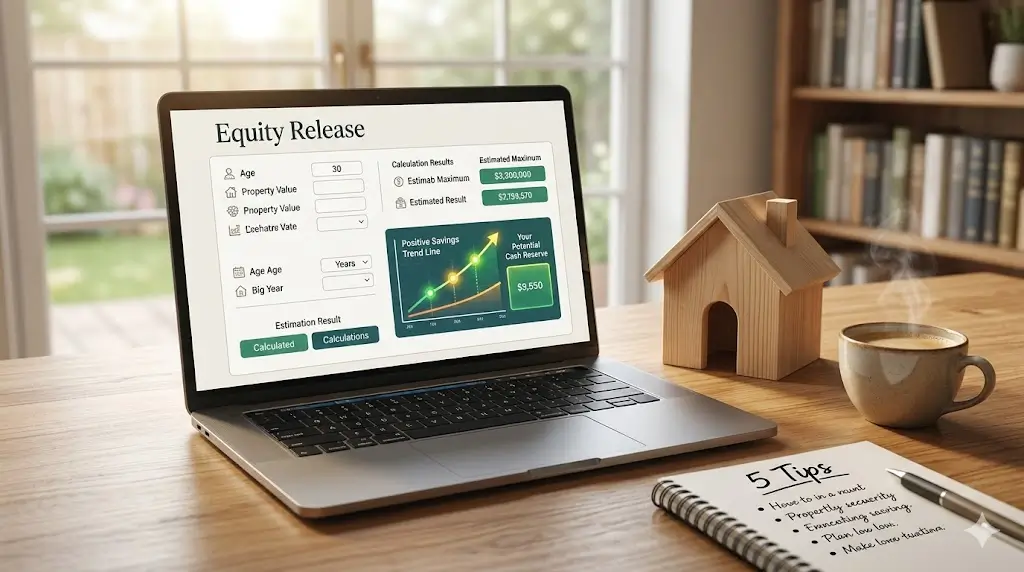
Don’t just jump at the first offer you see. Find a reputable, independent calculator. Input your age, property value, and outstanding mortgage balance. Pro Tip: Always calculate based on the minimum amount you actually need for your business venture, not the maximum amount the lender will give you.
Step 2: Seek Independent Financial and Legal Advice
You cannot bypass this step. An advisor will review your plans for generating passive income and ensure that a lifetime mortgage or home reversion plan makes mathematical sense compared to the expected ROI of your online business.
Step 3: Choose a Drawdown Plan Over a Lump Sum
If your goal is to fund an online business, you likely don’t need £50,000 on day one. A drawdown plan allows you to take smaller chunks of cash as your business hits specific milestones. Insider Trick: You only pay interest on the money you have actually withdrawn, saving you thousands over the long term.
Step 4: Deploy Capital into High-ROI Revenue Streams
Once the funds clear, deploy them strictly according to your business plan. Whether you are investing in inventory for Amazon FBA, paying for high-income skill courses (like SEO or coding), or buying established blogs, treat the released equity as seed funding for your income potential.

Income Potential & Earnings Breakdown
When you unlock equity, you are trading home value for liquid capital. The goal is to ensure the profit margins of your new business outpace the compound interest of the equity release loan.
- Beginner Earnings (Months 1-6): Reinvesting £5,000 of equity into an affiliate marketing blog or drop-shipping store realistically yields $200 – $800/month as you learn the ropes.
- Intermediate Earnings (Months 6-18): With optimized monetization strategies, a £10,000 investment into digital assets can yield $1,500 – $4,000/month.
- Payment Structures: Digital income is often paid via Stripe, PayPal, or direct bank transfers on a rolling monthly basis, providing excellent cash flow.
- The Math: If your lifetime mortgage interest is 5.5% annually, but your digital business generates a conservative 15% annual return on the capital invested, you are effectively growing your wealth faster than the loan grows.
Alternative Methods & Variations
If using an equity release calculator money saving expert approach reveals that the costs are too high, consider these alternatives to fund your online journey:
- Downsizing: Sell your current large home, buy a smaller, cheaper property, and use the leftover cash (which is entirely interest-free) to fund your digital enterprise.
- Traditional Remortgaging: If you still have a steady income, a standard remortgage often features significantly lower interest rates than equity release.
- Zero-Capital Side Hustles: Start a service-based work from home business (like freelance writing, virtual assisting, or graphic design) that requires zero initial investment. Use the profits from this to fund larger projects.
Best Practices & Optimization Tips
To maximize your chances of success and protect your estate, follow these serving suggestions:
- Ring-fence Your Capital: Open a dedicated business bank account for your released equity. Never mix it with your grocery or utility money.
- Invest in Education First: Don’t spend £10,000 on digital ads if you don’t understand marketing. Spend £500 on a high-quality course to increase your efficiency and protect your capital.
- Leverage AI Tools: Maximize your online earnings by using AI writers, automated social media schedulers, and CRM tools to do the work of a full team on a solo budget.
- Check the “No Negative Equity Guarantee”: Ensure your equity release plan includes this clause so you never pass on debt to your family, regardless of what happens to the housing market.
Common Mistakes to Avoid
- Borrowing the Maximum Amount: Just because the calculator says you can take £100,000 doesn’t mean you should. Compound interest will eat your estate quickly if the money sits idle.
- Falling for “Get Rich Quick” Schemes: Do not invest your hard-earned property equity into unproven crypto tokens or sketchy multi-level marketing (MLM) programs. Stick to proven digital business models.
- Ignoring Means-Tested Benefits: Releasing a large cash lump sum can immediately disqualify you from certain government benefits or pension credits. Always verify this with your advisor.
Long-Term Sustainability & Growth
The ultimate goal of combining equity release with online business is to build a self-sustaining ecosystem.
- Reinvestment: Take the first year of profits from your digital income and reinvest 50% back into the business to scale operations, while using the other 50% to build a liquid emergency fund.
- Diversification: Don’t rely on a single traffic source or affiliate partner. Build multiple revenue streams (e.g., YouTube ad revenue, digital product sales, and consulting) to future-proof your income.
- Voluntary Repayments: Many modern equity release plans allow you to pay off up to 10% of the loan amount per year penalty-free. Use your online profits to service the interest, preserving the remaining equity in your home for your heirs.
Conclusion
Using an equity release calculator money saving expert methodology is the smartest way to determine if your property holds the key to your financial freedom. By carefully calculating your needs, opting for a drawdown plan, and investing that capital into proven, scalable digital businesses, you can comfortably build profitable revenue streams from your living room.
Ready to start your journey? Drop your questions in the comments below! Have you checked your property’s potential yet? Subscribe to our newsletter for weekly online money-making strategies, and share your progress in our community!
FAQs
How much money can I realistically make by investing my released equity online?
Earnings vary wildly based on the business model. However, investing £5,000 to £10,000 properly into an e-commerce or content business can realistically yield $500 to $2,000 per month within the first 6 to 12 months with consistent effort.
Do I need prior business experience to start?
No prior experience is necessary, but a willingness to learn is required. It is highly recommended to allocate a small portion of your released funds toward high-quality education and courses before spending on inventory or ads.
What is the initial investment required for equity release?
While the equity release itself provides you with cash, setting it up involves costs. Expect to pay between £1,500 and £3,000 for independent financial advice, legal fees, and property valuation fees. These can often be deducted from the loan amount.
How long until I see results from my digital income streams?
The equity release process takes 4-8 weeks. Once the funds are invested into your online business, most entrepreneurs see their first profits within 60 to 90 days, depending on their chosen niche and daily time commitment.
Is equity release still a safe strategy in 2026?
Yes, provided you use an Equity Release Council (ERC) approved provider. These plans feature a ‘no negative equity guarantee,’ meaning you will never owe more than the value of your home when it is eventually sold.
What are the risks involved in this strategy?
The two main risks are compound interest quickly reducing the inheritance you leave behind, and the inherent risk of business failure. This is why a drawdown plan and a strict, well-researched business plan are essential to protect your capital.
Before you go, tap those stars!
Straightforward, no gimmicks, just solid banking advice
I clicked on this article expecting it to push some specific bank or financial product with referral links. I was pleasantly surprised. The advice was unbiased, focused on principles rather than promoting any particular institution, and gave me a clear framework to evaluate my own options. I appreciated that the article addressed the importance of FDIC insurance, automatic transfers, and goal-setting — things that seem obvious but that most people (including me) overlook. The writing was clear and concise, without the usual fluff or overly complex financial jargon. The only reason I’m giving four stars instead of five is that I would have liked even more detail on how to balance saving with paying down debt. Still, this was one of the most practical and trustworthy articles on saving I’ve read in a long time. Highly recommend.
Solid advice that cuts through the noise
I’ve been saving for years, but I kept wondering if my money was actually working as hard as it could be. There’s so much conflicting information out there — regular savings accounts, money market accounts, CDs, high-yield options — it gets confusing fast. This article did an excellent job comparing the options side by side, explaining the pros and cons of each, and helping me figure out which strategy made sense for my situation. I especially appreciated the section on the importance of emergency funds versus long-term savings, and the breakdown of how compound interest really adds up over time. I ended up moving my savings to a high-yield account and setting clearer goals. Practical, well-researched, and genuinely helpful.
Small changes, noticeable results
I’ll be honest — I clicked on this article expecting generic advice like “drive less” (thanks, captain obvious). But I was genuinely impressed. The article breaks down the actual science behind why certain habits affect fuel economy, with real numbers to back it up. I learned that my lead-foot acceleration and speeding were costing me way more than I realized. The section on vehicle maintenance was especially valuable — I didn’t know a dirty air filter could impact mileage that much. The tone was straightforward, no fluff, no upselling expensive products. Just solid, practical advice that actually works. My fuel expenses dropped by about 15% last month without me changing my overall driving needs.
Finally, practical advice that doesn’t require buying a new car
As someone who drives over 400 miles a week for work, gas expenses have been crushing my budget. I’ve read countless articles that basically just say “buy an electric vehicle” — which isn’t helpful when that’s not in my budget. This article was a game-changer. The tips were immediately actionable: combining trips, checking tire pressure (I didn’t realize how much that affects mileage!), and using gas price apps. I started implementing these suggestions last month, and I’ve already saved about $40. The writing was clear, well-organized, and respected that not everyone can just trade in their car. Highly recommend for anyone feeling the pain at the pump.
Perfect for renters who can’t install solar panels
As someone who rents an apartment, I often feel limited when it comes to making my home more energy-efficient. I can’t just install new appliances or add insulation to the walls. This article was a lifesaver because it focused on renter-friendly solutions—things like weatherstripping for doors, smart power strips, and optimizing how I use my existing appliances. The writing was straightforward and didn’t assume I owned a home. My only small critique is that I would have loved even more rent-specific examples, but overall, this was incredibly helpful. My electric bill dropped by about $15 last month!