
Practical Ways to Save Money on Groceries Every Month
Did you know that the average household of four spends nearly $1,200 a month on food, but wastes up to 40% of it? For many aspiring entrepreneurs, the biggest barrier to starting a side hustle or achieving financial freedom isn’t a lack of ideas—it’s a lack of seed capital. What if I told you that finding the most effective ways to save money on groceries is essentially like giving yourself a tax-free raise of $200 to $400 every single month?
In the world of online earnings and digital income, we often focus on increasing revenue streams. However, optimizing your personal profit margins by cutting household waste is the fastest way to fund your passive income investments. In this guide, we will treat your kitchen like a business, applying professional monetization strategies to your shopping cart to ensure every dollar is working toward your long-term wealth.
What You’ll Need to Get Started
To transform your grocery habits into a wealth-building machine, you don’t need expensive software. You simply need a few basic tools and a shift in mindset.
- Inventory Tracking System: A simple notebook or a free app like Todoist or AnyList to track what you already have.
- Cashback & Coupon Apps: Free resources like Ibotta, Fetch Rewards, or Rakuten to turn receipts into digital income.
- Meal Planning Template: A physical or digital calendar to prevent “emergency” takeout spending.
- Initial Investment: $0. The best strategies for saving on food are purely behavioral.
- Advanced Resource (Optional): A vacuum sealer ($40-$60) to extend the shelf life of bulk purchases, though a standard freezer bag works for beginners.
Grocery Savings Calculator
Calculate your potential “tax-free raise” based on our guide.
Time Investment
Lowering your grocery bill is an active work from home project that pays off immediately. Unlike a new blog or YouTube channel that might take 6 months to monetize, grocery optimization shows results on your very next receipt.
- Setup Time: 1 hour (Download apps and audit your pantry).
- Weekly Commitment: 30–45 minutes for meal planning and list building.
- Timeline to First “Earnings”: Immediate. You will see a lower total at the register during your next trip.
- Realistic Data: Most beginners who follow these steps consistently see a 15-25% reduction in spending within the first 30 days.
Step-by-Step Implementation Guide
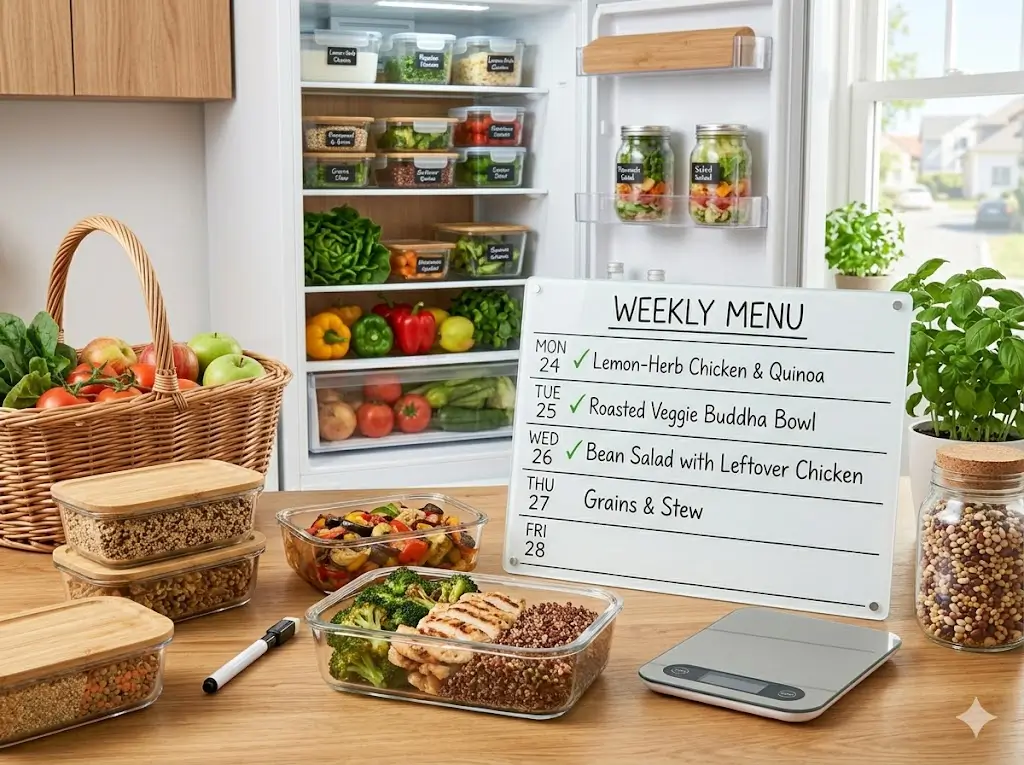
1. The “Reverse Meal Plan” Strategy
Most people look at recipes first, then buy ingredients. Professionals do the opposite.
- The Step: Look at what is already in your pantry and freezer. Build your weekly menu around those items first.
- Pro Tip: Use “The 3-Ingredient Rule.” If a recipe requires more than 3 items you don’t already own, find a different recipe.
2. Digital Coupon Stacking
Turn your shopping into a mini monetization strategy.
- The Step: Before heading to the store, check your store’s app for digital coupons. After the trip, scan your receipt into cashback apps.
- Insider Trick: Join “Buy Nothing” groups on social media. People often give away shelf-stable pantry items when they move.
3. Mastering Unit Pricing
Don’t be fooled by the large numbers on the price tag.
- The Step: Always look at the small “unit price” (price per ounce or gram) on the shelf tag. Often, the “Family Size” is actually more expensive per ounce than the standard size.
- Visual Description: Look for the orange or yellow sticker on the shelf edge; the unit price is usually in the bottom corner.
4. The “Store Brand” Swap
Generic brands are often manufactured in the same facilities as name brands.
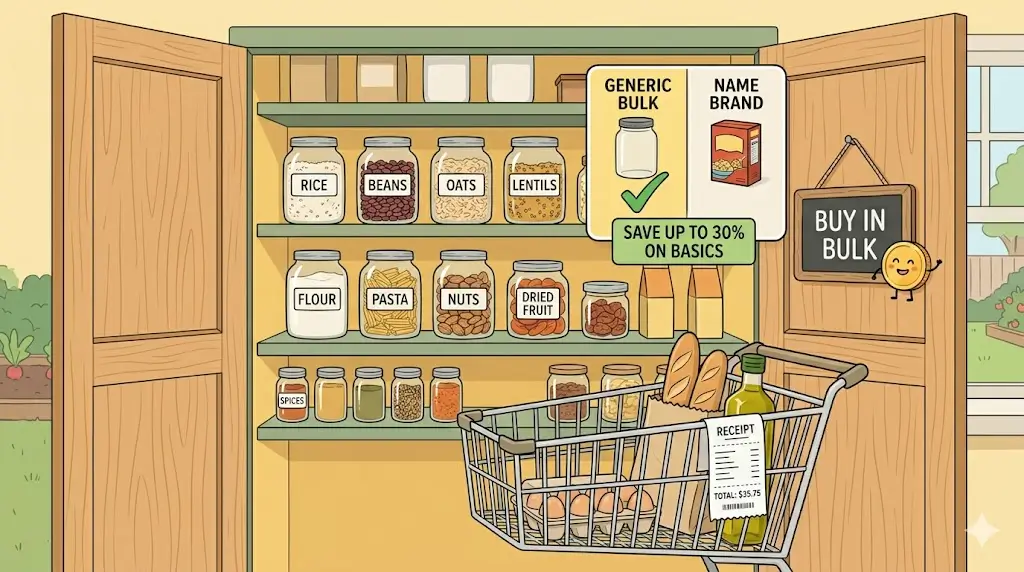
- The Step: Commit to buying the store brand for staples like salt, flour, frozen veggies, and canned beans.
- Common Question: Does it taste different? For basic ingredients, the difference is scientifically negligible, but the price difference is often 30-50%.

Income Potential & Earnings Breakdown
Let’s treat your savings as a revenue stream. By implementing these ways to save money on groceries, here is the realistic “income” you can expect to reclaim:
| Strategy | Monthly Savings Range | Annual Potential |
|---|---|---|
| Meal Planning (No Waste) | $80 – $150 | $960 – $1,800 |
| Store Brand Swaps | $40 – $70 | $480 – $840 |
| Cashback & Coupon Apps | $15 – $30 | $180 – $360 |
| Bulk Buying Staples | $20 – $45 | $240 – $540 |
| Total Reclaimed Income | $155 – $295 | $1,860 – $3,540 |
This $3,540 per year isn’t just “saved money.” If you invest that into an index fund with an 8% return, it could grow into over $50,000 in ten years. That is the definition of financial freedom.
Alternative Methods & Variations
- The “Aldi” Method: Switching to deep-discount grocers can slash bills by 40% without using a single coupon.
- Niche Scaling (The Bulk Strategy): If you have the storage space, buying half a cow from a local farmer or 25lb bags of rice from an ethnic grocery store can lower your cost-per-meal to under $1.50.
- The “Flash Food” Variation: Use apps like FlashFood or TooGoodToGo to buy items nearing their sell-by date at 50-90% off.
Best Practices & Optimization Tips
- Shop Alone: Data shows that shopping with partners or children increases impulse buys by up to 25%.
- Listen to Upbeat Music: Grocery stores play slow music to make you walk slower and see more items. Bring your own headphones and listen to a fast-paced podcast about passive income to keep your pace quick.
- Use a Basket, Not a Cart: If you only need a few items, don’t get a cart. You are less likely to buy a 5lb bag of oranges you don’t need if you have to carry it.
Common Mistakes to Avoid
- Shopping While Hungry: This is the #1 killer of profit margins. You will buy 17% more food than you need if your stomach is growling.
- Buying Pre-Cut Produce: You are paying a 300% markup for someone else to chop your onions. Spend 5 minutes with a knife and “pay yourself” that difference.
- Ignoring the “Sales Cycle”: Most items (coffee, cereal, meat) go on a 6-12 week sales cycle. Never buy these at full price; buy enough during the sale to last until the next one.
Long-Term Sustainability & Growth
To turn these habits into long-term growth, you must have a plan for the “extra” money. If you save $200 on groceries but spend it on a new video game, you haven’t improved your financial position.
- Automate: At the end of every month, calculate your grocery savings and transfer that exact amount into a high-yield savings account.
- Diversify: Use that capital to fund a digital income project, such as an e-book or a small Shopify store.
- Future-Proof: As your income potential grows, keep your grocery budget flat. This is called “preventing lifestyle creep.”
Conclusion
Saving on food is the ultimate side hustle because the barrier to entry is non-existent. By mastering these ways to save money on groceries, you aren’t just cutting costs—you are generating the capital necessary to fuel your dreams. Whether you want to invest in stocks, launch a blog, or achieve financial freedom, your journey starts in the supermarket aisles.
Ready to start your journey? Drop your best grocery-saving hack in the comments! Subscribe for weekly money-making strategies.
FAQs
How much money can I realistically make from grocery savings?
While it varies by family size, the average person can “earn” back $100-$200 per month by eliminating impulse buys and waste.
Do I need prior experience in budgeting?
No. Start with one habit—like only buying what is on your list—and build from there.
What’s the initial investment?
Zero. In fact, your investment is negative because you will spend less the very first time you shop using these steps.
Is this method still working in 2027?
With inflation at historic highs, these strategies are more effective now than ever before. Saving money is the only “investment” that becomes more valuable as prices rise.
What are the risks involved?
The only risk is “frugality fatigue.” Don’t cut your budget so thin that you hate your meals. Allow for a “fun food” budget to keep the strategy sustainable.
Before you go, tap those stars!
Straightforward, no gimmicks, just solid banking advice
I clicked on this article expecting it to push some specific bank or financial product with referral links. I was pleasantly surprised. The advice was unbiased, focused on principles rather than promoting any particular institution, and gave me a clear framework to evaluate my own options. I appreciated that the article addressed the importance of FDIC insurance, automatic transfers, and goal-setting — things that seem obvious but that most people (including me) overlook. The writing was clear and concise, without the usual fluff or overly complex financial jargon. The only reason I’m giving four stars instead of five is that I would have liked even more detail on how to balance saving with paying down debt. Still, this was one of the most practical and trustworthy articles on saving I’ve read in a long time. Highly recommend.
Solid advice that cuts through the noise
I’ve been saving for years, but I kept wondering if my money was actually working as hard as it could be. There’s so much conflicting information out there — regular savings accounts, money market accounts, CDs, high-yield options — it gets confusing fast. This article did an excellent job comparing the options side by side, explaining the pros and cons of each, and helping me figure out which strategy made sense for my situation. I especially appreciated the section on the importance of emergency funds versus long-term savings, and the breakdown of how compound interest really adds up over time. I ended up moving my savings to a high-yield account and setting clearer goals. Practical, well-researched, and genuinely helpful.
Small changes, noticeable results
I’ll be honest — I clicked on this article expecting generic advice like “drive less” (thanks, captain obvious). But I was genuinely impressed. The article breaks down the actual science behind why certain habits affect fuel economy, with real numbers to back it up. I learned that my lead-foot acceleration and speeding were costing me way more than I realized. The section on vehicle maintenance was especially valuable — I didn’t know a dirty air filter could impact mileage that much. The tone was straightforward, no fluff, no upselling expensive products. Just solid, practical advice that actually works. My fuel expenses dropped by about 15% last month without me changing my overall driving needs.
Finally, practical advice that doesn’t require buying a new car
As someone who drives over 400 miles a week for work, gas expenses have been crushing my budget. I’ve read countless articles that basically just say “buy an electric vehicle” — which isn’t helpful when that’s not in my budget. This article was a game-changer. The tips were immediately actionable: combining trips, checking tire pressure (I didn’t realize how much that affects mileage!), and using gas price apps. I started implementing these suggestions last month, and I’ve already saved about $40. The writing was clear, well-organized, and respected that not everyone can just trade in their car. Highly recommend for anyone feeling the pain at the pump.
Perfect for renters who can’t install solar panels
As someone who rents an apartment, I often feel limited when it comes to making my home more energy-efficient. I can’t just install new appliances or add insulation to the walls. This article was a lifesaver because it focused on renter-friendly solutions—things like weatherstripping for doors, smart power strips, and optimizing how I use my existing appliances. The writing was straightforward and didn’t assume I owned a home. My only small critique is that I would have loved even more rent-specific examples, but overall, this was incredibly helpful. My electric bill dropped by about $15 last month!