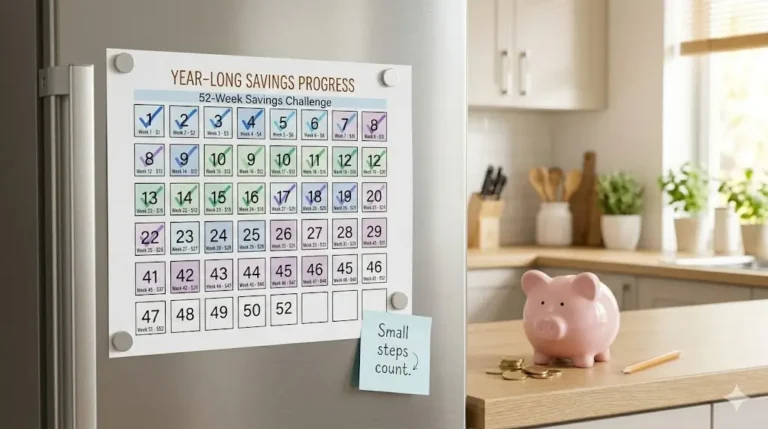

Why Small Daily Spending Impacts Long-Term Savings
Did you know that an estimated 82% of aspiring online entrepreneurs fail to launch their first business simply because they believe they “don’t have the startup capital”—all while unintentionally bleeding thousands of dollars through micro-transactions? We often fixate on major purchases like cars or rent, but it is actually the mastery of spending psychology that determines your financial destiny.
Those seemingly harmless $5 coffees, $12 subscription boxes, and quick $8 lunches act as silent wealth killers. Understanding the intricacies of your spending psychology is the absolute first step toward achieving financial freedom. Before you can successfully build robust revenue streams or launch a profitable side hustle, you must learn how to plug the leaks in your current cash flow.
In this comprehensive guide, we will break down exactly how small daily expenses destroy your ability to invest, and more importantly, how to redirect that wasted cash into powerful assets that generate lasting online earnings.
What You’ll Need to Get Started
You do not need an advanced degree in finance to conquer your micro-spending habits. Treat this phase as the initial setup of your personal wealth-building business.
Here is what you’ll need to overhaul your financial foundation:
- Digital Expense Tracking Tool: Cost: $0 – $10/month. Apps like YNAB (You Need A Budget), EveryDollar, or a simple, automated Google Sheet to visualize your daily outflows.
- A Dedicated “Seed Capital” Account: Cost: Free. A separate High-Yield Savings Account (HYSA) or brokerage account where your recovered funds will live.
- A 90-Day Bank Statement Audit: Cost: Free. Raw data from your past three months of spending to identify your unique psychological triggers.
- A “Capital Allocator” Mindset: Cost: Mental Energy. The willingness to view every saved dollar not as deprivation, but as an employee waiting to go out and earn you passive income.
Don’t miss an update. Join our newsletter.
Time Investment
Mastering your daily financial habits requires consistency, but the daily time commitment is surprisingly small compared to the massive long-term payout.
- Setup Time Required: 2 to 3 hours to gather your bank statements, categorize your past expenses, and set up your tracking software.
- Daily/Weekly Time Commitment: 5 minutes daily for a quick ledger review, plus a 20-minute weekly reconciliation.
- Timeline to First Results: Most beginners see a profound shift in their bank balances and financial confidence in 60-90 days with consistent effort. By month three, the capital accumulated from stopping small leaks is typically enough to fund the initial software or hosting for a work from home business.

Step-by-Step Implementation Guide
Step 1: Conduct a Ruthless Micro-Transaction Audit
Your brain is wired to ignore small purchases. To combat this, print out your last 90 days of transactions. Highlight every single purchase under $20. Group them into categories (e.g., convenience food, digital subscriptions, mobile games). This exercise bypasses your emotional blinders and forces you to confront the mathematical reality of your spending psychology.
Step 2: Calculate the “Opportunity Cost”
A $5 latte doesn’t just cost $5; it costs you the future value of that money. If you spend $15 a day on random conveniences, that’s $450 a month. Use an online compound interest calculator to see what $450 a month looks like invested over 10 years. Realizing that a daily habit is costing you over $80,000 in future wealth is a massive psychological deterrent.
Step 3: Implement the “24-Hour Friction” Rule
Online retailers spend billions optimizing their platforms to trigger instant purchases. Fight back by adding friction. Remove saved credit card details from your browser and phone. For any non-essential purchase, force a mandatory 24-hour waiting period. This gives your logical brain time to override your emotional impulse.
Step 4: Automate the Redirection of Funds
If you stop spending $10 a day but leave that money in your checking account, you will accidentally spend it on something else. You must automate your success. Calculate your average weekly micro-spending, cut it in half, and set up an automatic weekly transfer of that amount directly into your investment or business funding account.
- Pro Tip: Name this transfer something motivating within your banking app, such as “Digital Empire Fund,” to reinforce your ultimate goal.
Income Potential & Earnings Breakdown
How does cutting out daily snacks translate to real wealth? By improving your personal profit margins, you create the liquidity required to buy assets. Here is a realistic look at your income potential when you redirect daily micro-spending into investments:
| Daily Amount Saved | Monthly Capital Generated | Potential Deployment Strategy | 10-Year Projected Value (at 7% return) |
|---|---|---|---|
| $5.00 / day | ~$150 / month | Seed money for freelance tools / basic index funds | ~$26,000 |
| $10.00 / day | ~$300 / month | Funding a blog, e-commerce ads, or dividend stocks | ~$52,000 |
| **$20.00 / day** | ~$600 / month | Aggressive passive income investing & business scaling | ~$104,000 |
Disclaimer: Earnings, specific income amounts, and market returns are illustrative. Investing and entrepreneurship involve inherent risks.
Alternative Methods & Variations
If tracking every single $3 purchase causes you anxiety, try these alternative frameworks to manage your daily outflows:
- The Cash-Only Envelope System: Withdraw a set amount of physical cash for your weekly discretionary spending. When the cash is gone, you are done spending. The physical pain of handing over cash triggers loss aversion, naturally curbing waste.
- The “Zero-Based” Approach: Allocate every single dollar of your income to a specific job before the month begins. If “coffee shop runs” aren’t in the budget, the card gets declined.
- The Revenue-Matching Strategy: For those already dabbling in a side hustle, mandate that you cannot spend money on daily “wants” unless you have generated an equal amount of digital income that day to cover it.
Best Practices & Optimization Tips
To accelerate your progress and permanently fix your spending psychology, leverage these optimization techniques:
- Gamify the Process: Challenge yourself to “No-Spend Weekends” or see how many consecutive days you can go without a micro-transaction.
- Audit Subscriptions Quarterly: “Set it and forget it” subscriptions are the worst offenders of the micro-spending world. Use an app like Rocket Money to hunt down and cancel forgotten software and streaming services.
- Focus on Value, Not Deprivation: Instead of thinking “I can’t buy coffee,” reframe it as “I am choosing to buy high-quality monetization strategies for my future business.”
Common Mistakes to Avoid
Even highly motivated individuals stumble when trying to fix their daily spending habits. Watch out for these common pitfalls:
- The “Cold Turkey” Burnout: Cutting out 100% of your small joys immediately will lead to resentment and a massive spending binge. Prevention: Budget a small, strict allowance for guilt-free daily spending.
- Ignoring the “Latte Factor” Variations: You might not buy lattes, but maybe your weakness is $0.99 app purchases or fast-shipping fees. Prevention: Audit your own data; don’t just follow generic advice.
- Saving Without a Purpose: Hoarding the saved money in a zero-interest account means you are losing it to inflation. You must deploy it into assets to truly benefit.
Long-Term Sustainability & Growth
Fixing your daily spending is not a 30-day challenge; it is a foundational pillar for lifelong wealth creation.
To ensure long-term sustainability, you must continuously reinvest your recovered capital. As your self-discipline yields a growing pool of cash, begin diversifying. Use the first $1,000 to launch your online business. As that business generates its own revenue streams, use the profits to buy dividend-yielding stocks or real estate. By mastering the psychology of small money, you earn the right to manage—and multiply—big money.
Conclusion
Understanding your spending psychology and plugging the leaks of small daily transactions is the unglamorous, yet incredibly powerful secret to funding your entrepreneurial dreams. By auditing your habits, adding friction to your purchases, and redirecting your saved cash, you instantly create the capital needed to change your life.
Ready to start your journey? Drop your biggest daily spending weakness in the comments below! Subscribe for our weekly money-making strategies, share your progress in our community, and download our free financial starter guide to begin building your empire today!
FAQs
How much money can I realistically make by cutting daily expenses?
Cutting expenses preserves capital. If you cut out $15 of daily micro-spending, you save about $450 a month. By investing that $450 into assets yielding a 7% average historical return, it can grow to over $80,000 in a decade.
Do I need prior experience in finance to manage this?
No prior experience is necessary. Mastering your daily spending relies entirely on behavioral psychology and self-discipline, not complex financial modeling. Anyone can start by simply tracking their receipts.
What’s the initial investment required to start tracking?
The monetary investment is absolutely zero. You can use free spreadsheets or pen and paper. The only requirement is the time investment to review your daily transactions.
How long until I see results in my savings?
You will notice a cash surplus within the very first week of halting micro-transactions. Significant psychological shifts and a measurable accumulation of seed capital typically occur within 60 to 90 days.
Is this method still working in 2026?
Yes. While the cost of small conveniences has risen with inflation, the core mathematical principle remains unchanged: unmonitored daily spending drains wealth, and curbing it builds wealth, regardless of the economic climate.
What are the risks involved?
The main risk is “budget burnout” from depriving yourself too severely, which can trigger a rebound spending spree. Furthermore, there is an inflation risk if you successfully save the money but fail to invest it into income-producing assets.
Before you go, tap those stars!
Straightforward, no gimmicks, just solid banking advice
I clicked on this article expecting it to push some specific bank or financial product with referral links. I was pleasantly surprised. The advice was unbiased, focused on principles rather than promoting any particular institution, and gave me a clear framework to evaluate my own options. I appreciated that the article addressed the importance of FDIC insurance, automatic transfers, and goal-setting — things that seem obvious but that most people (including me) overlook. The writing was clear and concise, without the usual fluff or overly complex financial jargon. The only reason I’m giving four stars instead of five is that I would have liked even more detail on how to balance saving with paying down debt. Still, this was one of the most practical and trustworthy articles on saving I’ve read in a long time. Highly recommend.
Solid advice that cuts through the noise
I’ve been saving for years, but I kept wondering if my money was actually working as hard as it could be. There’s so much conflicting information out there — regular savings accounts, money market accounts, CDs, high-yield options — it gets confusing fast. This article did an excellent job comparing the options side by side, explaining the pros and cons of each, and helping me figure out which strategy made sense for my situation. I especially appreciated the section on the importance of emergency funds versus long-term savings, and the breakdown of how compound interest really adds up over time. I ended up moving my savings to a high-yield account and setting clearer goals. Practical, well-researched, and genuinely helpful.
Small changes, noticeable results
I’ll be honest — I clicked on this article expecting generic advice like “drive less” (thanks, captain obvious). But I was genuinely impressed. The article breaks down the actual science behind why certain habits affect fuel economy, with real numbers to back it up. I learned that my lead-foot acceleration and speeding were costing me way more than I realized. The section on vehicle maintenance was especially valuable — I didn’t know a dirty air filter could impact mileage that much. The tone was straightforward, no fluff, no upselling expensive products. Just solid, practical advice that actually works. My fuel expenses dropped by about 15% last month without me changing my overall driving needs.
Finally, practical advice that doesn’t require buying a new car
As someone who drives over 400 miles a week for work, gas expenses have been crushing my budget. I’ve read countless articles that basically just say “buy an electric vehicle” — which isn’t helpful when that’s not in my budget. This article was a game-changer. The tips were immediately actionable: combining trips, checking tire pressure (I didn’t realize how much that affects mileage!), and using gas price apps. I started implementing these suggestions last month, and I’ve already saved about $40. The writing was clear, well-organized, and respected that not everyone can just trade in their car. Highly recommend for anyone feeling the pain at the pump.
Perfect for renters who can’t install solar panels
As someone who rents an apartment, I often feel limited when it comes to making my home more energy-efficient. I can’t just install new appliances or add insulation to the walls. This article was a lifesaver because it focused on renter-friendly solutions—things like weatherstripping for doors, smart power strips, and optimizing how I use my existing appliances. The writing was straightforward and didn’t assume I owned a home. My only small critique is that I would have loved even more rent-specific examples, but overall, this was incredibly helpful. My electric bill dropped by about $15 last month!