
Simple Ways to Save on Groceries Without Sacrificing Quality
Did you know that the average household wastes over $1,500 a year simply because they mismanage their food budget and fall for supermarket psychological traps? When you are building wealth, optimizing your expenses is just as crucial as increasing your online earnings. If you want to save on groceries this year without resorting to a diet of plain rice and beans, you need to fundamentally shift how you view your weekly supermarket run.
Instead of treating food as a fixed, uncontrollable cost, view it as a prime opportunity to increase your personal profit margins. By applying basic business principles to your pantry, you can effectively save on groceries, freeing up hundreds of dollars a month. Every dollar you keep in your bank account is a step closer to financial freedom, acting as untaxed digital income. Let’s dive into the ultimate monetization strategies for your kitchen.
What You’ll Need to Get Started
Before you implement these grocery optimization techniques, you need to set up your operational framework. Think of this as the initial infrastructure for your new cost-saving side hustle.
- A Smartphone with a Camera: Required for receipt-scanning and cash-back applications.
- Digital or Physical Meal Planner: A simple spreadsheet (Google Sheets is free) or a dedicated notebook to map out inventory.
- Loyalty Program Accounts: Free to join; mandatory for accessing the lowest tiered pricing at your local supermarkets.
- A Dedicated “Savings” Account (Optional but Recommended): A place to automatically route the money you save to build your passive income streams.
- Initial Investment: $0.00. The beauty of this system is that it requires absolutely zero upfront capital.
Calculate Your Grocery Savings
Enter your average monthly grocery spend to see how much “digital income” you can unlock!
Your Projected Savings
Time Investment
Treating your grocery budget like a business requires a consistent, yet manageable, time commitment. The return on your invested time, however, rivals many traditional part-time jobs.
- Setup Time Required: 30 to 45 minutes (downloading necessary apps, setting up a master meal-planning spreadsheet, taking inventory of your current pantry).
- Daily/Weekly Time Commitment: 1-2 hours per week for strategic meal planning, digital coupon clipping, and targeted shopping.
- Timeline to First Earnings: Immediate. You will see a reduction in your grocery bill on your very first optimized shopping trip.
- Realistic Data: Most beginners see a 20-30% reduction in their food costs within 30-60 days with consistent effort, making this one of the highest-ROI activities you can do from home.

Step-by-Step Implementation Guide
1. Digitize and Systematize Your Meal Planning
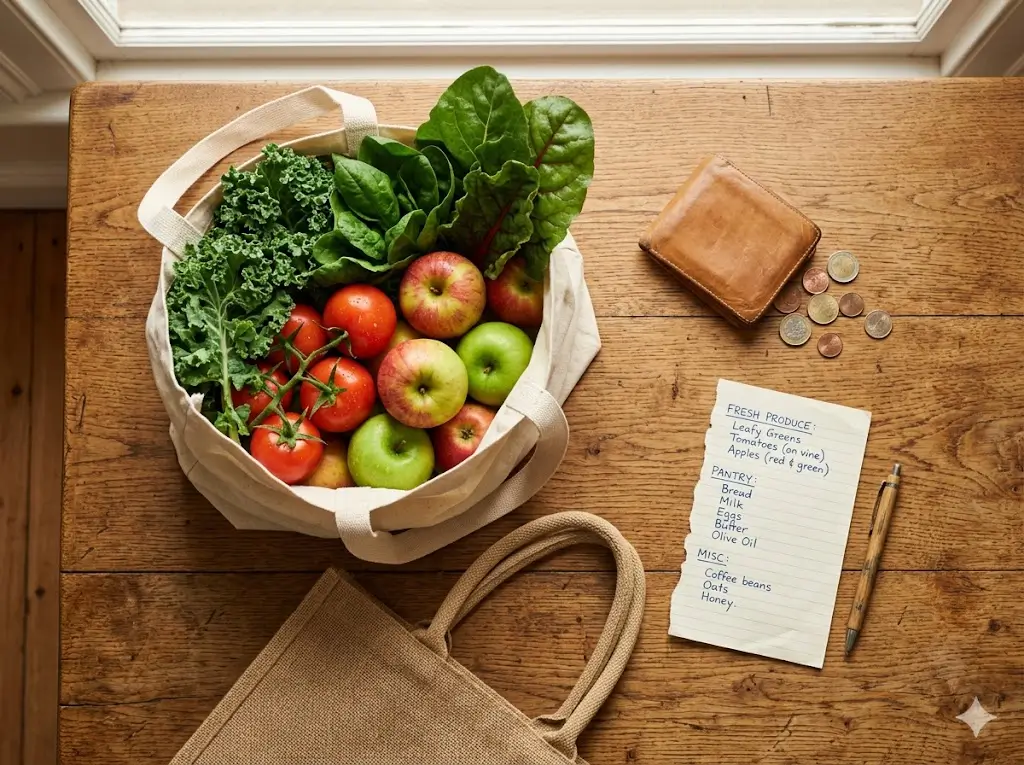
The foundation of being able to save on groceries is intentionality. Treat your Sunday meal prep planning like a critical work from home meeting. Open your grocery store’s app and look at the weekly loss leaders (the heavily discounted items on the front page). Build your week’s menu strictly around these proteins and seasonal produce.
2. Implement “Pantry First” Inventory Management
Before you write down a single item to buy, audit your current stock. Many households have hundreds of dollars of food sitting in the back of their freezers and pantries. By planning meals around what you already own, you prevent food waste and immediately slash your weekly bill. Think of this as liquidating excess inventory to boost your income potential.
3. Leverage Cash-Back and Receipt Scanning Apps
Transform your smartphone into a tool for digital income. Applications like Ibotta, Fetch Rewards, and Checkout 51 pay you for buying everyday items. Simply snap a photo of your receipt after you shop. While it might only be a few dollars per trip, these multiple revenue streams compound over the year, often resulting in hundreds of dollars in free gift cards or PayPal cash.
4. Master the “High-Low” Quality Strategy
You do not need to sacrifice quality to save money; you just need to be strategic about where you pay a premium. Splurge on high-quality, sustainably sourced proteins or specialty cheeses, but buy your foundational staples—like oats, rice, flour, canned beans, and frozen vegetables—in generic store brands. The quality difference in staples is statistically negligible, but the price difference is massive.
5. Utilize the Unit Price Metric
Ignore the flashy sale tags and look strictly at the unit price (the tiny number on the shelf tag that shows the cost per ounce or per 100 grams). Retailers frequently use deceptive packaging to make smaller items look like better deals. Optimizing your purchases based on unit price is the ultimate insider trick to ensure maximum profit margins on your food investments.
Income Potential & Earnings Breakdown
When you aggressively save on groceries, you are effectively paying yourself a tax-free dividend. Here is a realistic look at your monthly income potential when applying these strategies for a family of four currently spending $1,000/month:
- Strategic Meal Planning & Inventory: $150 – $200/month saved
- Switching to Generic Staples: $50 – $80/month saved
- Cash-Back Apps & Digital Coupons: $20 – $40/month earned
- Total Realistic Monthly “Earnings”: $220 to $320
Over a year, this equates to roughly $2,640 to $3,840 in retained capital. If you funnel this into investments, it becomes a powerful driver of passive income.
Alternative Methods & Variations
Depending on your living situation and local resources, you can scale these monetization strategies differently:
- The Warehouse Club Model: If you have the storage space, buying non-perishables and household goods in bulk at stores like Costco or Sam’s Club dramatically lowers your unit price.
- Community Supported Agriculture (CSA): Partner directly with local farms for a weekly box of seasonal produce. It’s often cheaper than supermarket organic sections and guarantees high quality.
- Online Grocery Pickup: A zero-cost alternative for those who struggle with impulse control. Ordering online prevents you from wandering the aisles and tossing unnecessary items into your cart, strictly enforcing your budget.
Best Practices & Optimization Tips
To maximize your efficiency and financial returns:
- Shop Solo: Bringing children or a hungry partner statistically increases the amount of impulse buys in your cart by up to 20%.
- Never Shop Hungry: Shopping on an empty stomach alters your decision-making, leading to high-cost, low-nutrition convenience food purchases.
- Create a Price Book: Keep a spreadsheet of the “rock bottom” prices for your 20 most frequently purchased items. Only stock up heavily when the price hits that target threshold.
Common Mistakes to Avoid
Even seasoned budgeters fall into supermarket traps that destroy their hard-earned savings:
- Falling for BOGO Traps: “Buy One, Get One 50% Off” is only a deal if you were already planning to buy the item. If you weren’t, you didn’t save 50%; you spent 150% more than you intended.
- Brand Loyalty Blindness: Refusing to try store brands because of perceived inferior quality costs the average shopper hundreds annually.
- Ignoring the Freezer: Fresh produce goes bad quickly. Buying frozen fruits and vegetables is often cheaper, lasts longer, and is flash-frozen at peak nutritional value. Neglecting the freezer aisle is a massive mistake.
Long-Term Sustainability & Growth
Successfully learning to save on groceries is a fantastic short-term win, but true wealth building requires long-term sustainability. The biggest mistake beginners make is leaving their saved grocery money in their checking account, where it inevitably gets spent on lifestyle creep.
To future-proof your finances, set up an automatic weekly transfer. If your grocery budget was $200 a week and you only spent $150, immediately transfer that $50 into a brokerage account or high-yield savings account. By diversifying your retained capital and utilizing automation opportunities, you turn your grocery savings into a self-sustaining engine for wealth.
Conclusion
You don’t need a six-figure salary to start building wealth; you just need to optimize your existing cash flow. By treating your pantry like a business, utilizing cash-back apps, and shopping with strategic intention, you can save on groceries without ever sacrificing the quality of your meals. This simple side hustle puts thousands of dollars back into your pocket every single year.
Ready to start your journey to optimized spending? Drop your biggest grocery budgeting questions in the comments below, share your progress in our community, and subscribe for weekly financial freedom strategies!
FAQs
How much money can I realistically make/save?
Most households who actively implement meal planning, unit-price tracking, and cash-back apps can realistically reduce their grocery bill by 20% to 30%, which translates to hundreds of dollars a month in retained income.
Do I need prior experience?
None at all. These strategies require zero specialized skills or financial background. Anyone with a smartphone and a willingness to plan ahead can succeed.
What’s the initial investment?
There is absolutely zero initial investment required. Meal planning, checking unit prices, and downloading cash-back apps are all completely free.
How long until I see results?
You will see immediate financial results on your very next trip to the supermarket. The digital income from cash-back apps usually posts to your account within 24 to 48 hours of scanning a receipt.
Is this method still working in 2026?
Yes. While inflation affects baseline prices, the underlying mechanics of supermarket pricing, loss leaders, and consumer data incentives (cash-back apps) remain highly effective monetization strategies.
What are the risks involved?
The only risk is “bulk buying” perishable items that you cannot consume before they spoil, which results in food waste and lost capital. Always prioritize shelf-stable items when buying in bulk.
Before you go, tap those stars!
Straightforward, no gimmicks, just solid banking advice
I clicked on this article expecting it to push some specific bank or financial product with referral links. I was pleasantly surprised. The advice was unbiased, focused on principles rather than promoting any particular institution, and gave me a clear framework to evaluate my own options. I appreciated that the article addressed the importance of FDIC insurance, automatic transfers, and goal-setting — things that seem obvious but that most people (including me) overlook. The writing was clear and concise, without the usual fluff or overly complex financial jargon. The only reason I’m giving four stars instead of five is that I would have liked even more detail on how to balance saving with paying down debt. Still, this was one of the most practical and trustworthy articles on saving I’ve read in a long time. Highly recommend.
Solid advice that cuts through the noise
I’ve been saving for years, but I kept wondering if my money was actually working as hard as it could be. There’s so much conflicting information out there — regular savings accounts, money market accounts, CDs, high-yield options — it gets confusing fast. This article did an excellent job comparing the options side by side, explaining the pros and cons of each, and helping me figure out which strategy made sense for my situation. I especially appreciated the section on the importance of emergency funds versus long-term savings, and the breakdown of how compound interest really adds up over time. I ended up moving my savings to a high-yield account and setting clearer goals. Practical, well-researched, and genuinely helpful.
Small changes, noticeable results
I’ll be honest — I clicked on this article expecting generic advice like “drive less” (thanks, captain obvious). But I was genuinely impressed. The article breaks down the actual science behind why certain habits affect fuel economy, with real numbers to back it up. I learned that my lead-foot acceleration and speeding were costing me way more than I realized. The section on vehicle maintenance was especially valuable — I didn’t know a dirty air filter could impact mileage that much. The tone was straightforward, no fluff, no upselling expensive products. Just solid, practical advice that actually works. My fuel expenses dropped by about 15% last month without me changing my overall driving needs.
Finally, practical advice that doesn’t require buying a new car
As someone who drives over 400 miles a week for work, gas expenses have been crushing my budget. I’ve read countless articles that basically just say “buy an electric vehicle” — which isn’t helpful when that’s not in my budget. This article was a game-changer. The tips were immediately actionable: combining trips, checking tire pressure (I didn’t realize how much that affects mileage!), and using gas price apps. I started implementing these suggestions last month, and I’ve already saved about $40. The writing was clear, well-organized, and respected that not everyone can just trade in their car. Highly recommend for anyone feeling the pain at the pump.
Perfect for renters who can’t install solar panels
As someone who rents an apartment, I often feel limited when it comes to making my home more energy-efficient. I can’t just install new appliances or add insulation to the walls. This article was a lifesaver because it focused on renter-friendly solutions—things like weatherstripping for doors, smart power strips, and optimizing how I use my existing appliances. The writing was straightforward and didn’t assume I owned a home. My only small critique is that I would have loved even more rent-specific examples, but overall, this was incredibly helpful. My electric bill dropped by about $15 last month!