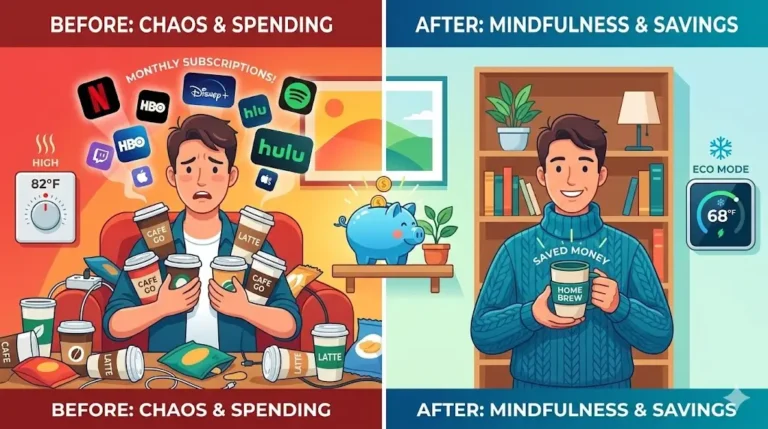

Minimalism and Frugal Living: Understanding the Difference
Did you know that 76% of aspiring digital entrepreneurs fail to launch their online business simply because they claim they “lack the initial capital”—while simultaneously sitting in homes filled with unused items and leaking hundreds of dollars in unnecessary expenses each month?
If you are serious about achieving absolute financial freedom, mastering frugal living and minimalism is not just a lifestyle choice; it is your ultimate business launchpad. While these two concepts are frequently used interchangeably, they are fundamentally different. Frugal living focuses on maximizing your financial resources by spending less, whereas minimalism focuses on intentionally removing excess to maximize your time, space, and mental energy.
When you understand the difference and learn to implement both, you instantly clear the physical clutter blocking your work from home productivity, while simultaneously reducing expenses to increase your personal profit margins. Every dollar saved and every item sold becomes tax-free capital that can be directly routed into your digital empire. Let’s explore how to leverage both philosophies to build lasting wealth.
What You’ll Need to Get Started
You do not need an accountant, a life coach, or thousands of dollars to restructure your lifestyle for maximum efficiency. Treating your transition into frugal living and minimalism as your first real side hustle requires only a few accessible tools:
- Financial Auditing Tools: A free spreadsheet (Google Sheets) or budgeting app (like YNAB or EveryDollar) to track where your money is currently leaking.
- Liquidation Platforms: Accounts on eBay, Facebook Marketplace, or Mercari to turn physical clutter into instant online earnings.
- A “Value vs. Cost” Framework: A mental checklist to evaluate if an item or expense brings you genuine value (Minimalism) and if you are paying the lowest possible price for it (Frugal Living).
- Initial Investment: $0. Your only investment is your time and willingness to ruthlessly evaluate your lifestyle.
- Required Skills: Basic organization, willingness to negotiate, and a beginner-level understanding of online selling.
Don’t miss an update. Join our newsletter.
Time Investment
One of the most attractive aspects of streamlining your life is that it pays you back in both cash and reclaimed time.
- Setup Time Required: 1 to 2 weekends for a deep house declutter and a comprehensive financial audit.
- Daily/Weekly Time Commitment: 15 to 30 minutes a week reviewing budgets and maintaining a clutter-free workspace.
- Timeline to First Earnings: Immediate. You can list an unused item online today and see your first digital income within 24 hours.
- Comparative ROI: Most beginners see results in 60-90 days with consistent effort in traditional online businesses. By contrast, combining minimalism (selling assets) and frugal living (cutting costs) yields a 100% return on your time investment in week one.

Step-by-Step Implementation Guide
Follow these actionable steps to harness the power of both philosophies, turning your optimized life into a well-funded business machine.
Step 1: The “Minimalist First” Sweep
Before you try to save money on buying things (frugality), figure out what you actually need (minimalism). Go through your home room by room. If you haven’t used an item in 6 months, it is taking up physical and mental real estate.
- Pro Tip: Don’t just throw things away. Box up high-value electronics, gently used clothes, and furniture. This is your untrapped capital.
Step 2: Liquidate and Monetize (The Minimalism Profit)
Take the items you separated in Step 1 and apply basic monetization strategies. Take well-lit photos, write SEO-friendly descriptions, and list them on local and digital marketplaces.
- Insider Trick: Route every single dollar you make from selling clutter directly into a separate, high-yield business savings account. Do not use this money for groceries.
Step 3: The “Frugal Living” Expense Audit
Now that your space is clear, clear your budget. Frugal living is about getting the best value. Look at your recurring bills, grocery spending, and utilities. Can you switch to a cheaper generic brand? Can you negotiate your internet bill down by $20 a month?
- Actionable Task: Aim to cut just 15% of your monthly overhead through aggressive price comparisons and couponing.
Step 4: Combine the Forces for Business Growth
Use the clean, minimalist space in your home to set up an optimal work from home environment. Use the money generated from selling clutter and the monthly cash freed up by your frugal living habits to buy web hosting, run ads, or invest in courses. You have just funded a business for free.

Income Potential & Earnings Breakdown
How much capital can you actually generate by understanding and applying these concepts? Here is a realistic look at the income potential of optimizing your lifestyle:
| Strategy Applied | Action Taken | Average Capital Generated | Primary Benefit |
|---|---|---|---|
| Minimalism (One-Time) | Selling unused tech, clothing, and furniture. | $500 – $1,500+ | Generates immediate seed capital for online ventures. |
| Frugal Living (Monthly) | Cutting subscriptions, meal planning, negotiating bills. | $150 – $400 / month | Creates recurring, tax-free cash flow to fund business operations. |
| Combined Synergies | Reinvesting the above into a digital side hustle. | Limitless | Transforms saved/earned capital into compounding passive income. |
Disclaimer: Results vary based on your starting financial baseline, geographic location, and the amount of physical items you have to liquidate.
Alternative Methods & Variations
If extreme minimalism or intense penny-pinching doesn’t fit your personality, there are several niche variations to explore:
- Essentialism: A softer approach to minimalism. Instead of owning exactly 33 items of clothing, you simply ensure that every item you own brings high value, regardless of the total count.
- Eco-Frugality: Focusing on saving money specifically through environmentally friendly choices, such as buying a reusable water bottle once instead of buying plastic bottles daily, or setting up a compost bin to grow your own food.
- Digital Minimalism: Applying the decluttering mindset to your screens. Unsubscribing from marketing emails, deleting time-wasting apps, and organizing your hard drives. This drastically improves focus for generating digital income.
Best Practices & Optimization Tips
To maximize your results and ensure these lifestyle changes stick, utilize these advanced optimization hacks:
- The 48-Hour Purchase Rule: Frugal living dictates you shouldn’t impulse buy. If you want something non-essential, wait 48 hours. 90% of the time, the urge will pass, saving your profit margins.
- Buy Refurbished for Business: When setting up your home office, apply frugality. A certified refurbished laptop from a reputable dealer performs identically to a new one but costs 40% less.
- Automate Your Savings: When you negotiate a bill down by $30 a month, set up an automatic bank transfer to move that exact $30 into your investment account every month. Out of sight, out of mind.
Common Mistakes to Avoid
When attempting to restructure spending and habits, many beginners fall into psychological traps. Avoid these costly pitfalls:
- Confusing “Cheap” with “Frugal”: Buying a $10 desk chair that breaks in two months and ruins your back is cheap. Buying a high-quality, ergonomic used Herman Miller chair for $300 that lasts a decade is frugal. Quality matters for long-term ROI.
- The “Declutter Regret” Loop: Throwing away items in a minimalist frenzy, only to realize you actually needed them and having to repurchase them at full retail price. Always box items up for 30 days before selling them to test if you truly can live without them.
- Hoarding Cash: Frugal living is pointless if the money just sits in a low-interest checking account losing value to inflation. The goal is to reinvest.
Long-Term Sustainability & Growth
The ultimate goal of distinguishing between and applying minimalism and frugal living is not just to have an empty house and a full piggy bank; it is to build generational wealth.
To ensure long-term sustainability, you must view your household as an enterprise. The reduced overhead (Frugality) and streamlined operations (Minimalism) create diverse revenue streams of “found money.” As these streams grow, employ reinvestment strategies. Put your liberated capital into dividend-paying index funds, real estate, or scalable digital assets like a niche blog or e-commerce store. By doing this, your lifestyle choices directly fund your future, completely future-proofing your finances.
Conclusion
Understanding the difference between minimalism and frugal living gives you a massive unfair advantage in the world of online entrepreneurship. Minimalism clears the distractions and generates initial liquid capital, while frugal living permanently lowers your overhead and increases your monthly cash flow. Together, they form the perfect foundation for building a lucrative, stress-free digital business.
Ready to start your journey and take control of your financial ecosystem? Drop your biggest budgeting or decluttering questions in the comments below! Don’t forget to subscribe for weekly money-making strategies, and be sure to download our free starter guide to launch your side hustle today.
FAQs
What is the main difference between minimalism and frugal living?
Minimalism is primarily concerned with intentionality, space, and reducing physical/mental clutter (buying only what brings value). Frugal living is primarily concerned with financial efficiency and resource allocation (paying the lowest possible price).
Do I need prior experience with budgeting to start frugal living?
No prior experience is necessary. Frugal living can start with simple, beginner-friendly actions like meal planning, using digital coupons, or negotiating a single utility bill.
How much money can I realistically make by selling my minimalist clutter?
While it varies per household, the average American home contains over $1,000 to $2,000 worth of unused electronics, clothing, and furniture that can be quickly liquidated on local marketplaces.
How long until I see results from these lifestyle changes?
You will see physical and mental results the very first weekend you declutter. You will see financial results within your first 30-day billing cycle as your expenses drop.
Are these methods still working in the current economy?
Yes, more than ever. With rising inflation, applying frugal living tactics is one of the only guaranteed ways to protect your purchasing power and maintain high personal profit margins.
What are the risks involved?
The risks are incredibly low. The main pitfall is taking minimalism to an extreme and getting rid of essential items, or taking frugality to an extreme and sacrificing your health or safety to save a few pennies. Balance is key.
Before you go, tap those stars!
Straightforward, no gimmicks, just solid banking advice
I clicked on this article expecting it to push some specific bank or financial product with referral links. I was pleasantly surprised. The advice was unbiased, focused on principles rather than promoting any particular institution, and gave me a clear framework to evaluate my own options. I appreciated that the article addressed the importance of FDIC insurance, automatic transfers, and goal-setting — things that seem obvious but that most people (including me) overlook. The writing was clear and concise, without the usual fluff or overly complex financial jargon. The only reason I’m giving four stars instead of five is that I would have liked even more detail on how to balance saving with paying down debt. Still, this was one of the most practical and trustworthy articles on saving I’ve read in a long time. Highly recommend.
Solid advice that cuts through the noise
I’ve been saving for years, but I kept wondering if my money was actually working as hard as it could be. There’s so much conflicting information out there — regular savings accounts, money market accounts, CDs, high-yield options — it gets confusing fast. This article did an excellent job comparing the options side by side, explaining the pros and cons of each, and helping me figure out which strategy made sense for my situation. I especially appreciated the section on the importance of emergency funds versus long-term savings, and the breakdown of how compound interest really adds up over time. I ended up moving my savings to a high-yield account and setting clearer goals. Practical, well-researched, and genuinely helpful.
Small changes, noticeable results
I’ll be honest — I clicked on this article expecting generic advice like “drive less” (thanks, captain obvious). But I was genuinely impressed. The article breaks down the actual science behind why certain habits affect fuel economy, with real numbers to back it up. I learned that my lead-foot acceleration and speeding were costing me way more than I realized. The section on vehicle maintenance was especially valuable — I didn’t know a dirty air filter could impact mileage that much. The tone was straightforward, no fluff, no upselling expensive products. Just solid, practical advice that actually works. My fuel expenses dropped by about 15% last month without me changing my overall driving needs.
Finally, practical advice that doesn’t require buying a new car
As someone who drives over 400 miles a week for work, gas expenses have been crushing my budget. I’ve read countless articles that basically just say “buy an electric vehicle” — which isn’t helpful when that’s not in my budget. This article was a game-changer. The tips were immediately actionable: combining trips, checking tire pressure (I didn’t realize how much that affects mileage!), and using gas price apps. I started implementing these suggestions last month, and I’ve already saved about $40. The writing was clear, well-organized, and respected that not everyone can just trade in their car. Highly recommend for anyone feeling the pain at the pump.
Perfect for renters who can’t install solar panels
As someone who rents an apartment, I often feel limited when it comes to making my home more energy-efficient. I can’t just install new appliances or add insulation to the walls. This article was a lifesaver because it focused on renter-friendly solutions—things like weatherstripping for doors, smart power strips, and optimizing how I use my existing appliances. The writing was straightforward and didn’t assume I owned a home. My only small critique is that I would have loved even more rent-specific examples, but overall, this was incredibly helpful. My electric bill dropped by about $15 last month!