
How Financial Discipline and a Strong Financial Mindset Shape Long-Term Successt
Did you know that 70% of lottery winners end up broke within seven years? This startling statistic proves a fundamental truth about money: without the right financial mindset, no amount of online earnings or passive income can secure your future.
Many aspiring entrepreneurs dive headfirst into side hustles hoping to solve their money problems with more money. But if your internal operating system—your financial discipline—is flawed, high revenue streams will only lead to higher spending, not wealth.
This guide isn’t just about saving pennies or skipping lattes. It is about fundamentally reshaping your relationship with money. We will explore how cultivating a disciplined financial mindset is the hidden engine behind financial freedom, allowing you to transform temporary profits into lasting legacy.
Whether you are looking to build a digital empire or simply secure your retirement, the journey starts between your ears.
What You’ll Need to Get Started
Building a resilient financial mindset requires a toolkit that blends psychology with practical tracking. You cannot improve what you do not measure.
Essential Tools & Resources:
- Automated Banking Framework: You need a checking account that automatically splits deposits into “Spending,” “Savings,” and “Investment” buckets.
- Net Worth Tracker: Tools like Personal Capital (Empower) or a custom Google Sheet to visualize your progress.
- The “Why” Journal: A simple physical notebook to document your emotional triggers around spending.
- Investment Vehicle: A brokerage account (e.g., Vanguard, Fidelity) to turn savings into passive income.
Skill Requirements:
- Delayed Gratification: The ability to sacrifice today’s luxury for tomorrow’s freedom.
- Emotional Detachment: Learning to view money as a tool, not a reflection of your self-worth.
- Basic Financial Literacy: Understanding compound interest and profit margins.
Initial Investment: $0.00 to $15.00 (for a notebook or app subscription). The real cost is the mental effort required to break old habits.
Don’t miss an update. Join our newsletter.
Time Investment
Changing a financial mindset is not an overnight hack; it is a neurological rewiring.
The Rewiring Timeline:
- The Assessment Phase (Week 1): Auditing your current beliefs and spending triggers.
- The Habit Formation (Days 1-66): Research from University College London suggests it takes an average of 66 days to form a new habit. During this time, discipline will feel difficult.
- The compound Effect (Year 1+): This is when you start seeing the “hockey stick” growth in your savings and digital income retention.
Reality Check: While you can set up the systems in an afternoon, the mindset shift typically takes 3 to 6 months of consistent practice to feel natural.

Step-by-Step Implementation Guide
Here is your blueprint for forging a bulletproof financial mindset that supports long-term wealth.
Step 1: Conduct a “Belief Audit”
Your current bank account is a lagging indicator of your past beliefs.
- Action: Write down your earliest memory of money. Was it scarce? Was it a source of conflict?
- The Pivot: Identify one limiting belief (e.g., “Rich people are greedy”) and rewrite it (e.g., “Money amplifies my ability to do good”).
Step 2: Implement the “Pay Yourself First” Protocol
Most people spend first and save what’s left. The disciplined mindset reverses this.
- Action: Set up an automatic transfer for 20% of every paycheck (or side hustle payout) to a separate account the morning it hits.
- Pro Tip: If 20% is too high, start with 1%. The habit is more important than the amount initially.
Step 3: The 24-Hour Purchase Rule
Impulse buying is the enemy of financial freedom.
- The Rule: For any non-essential purchase over $50, you must wait 24 hours.
- The Effect: This cooling-off period eliminates 80% of unnecessary spending, keeping your capital free for monetization strategies.
Step 4: Automate Your “Freedom Fund”
Willpower fatigues; automation does not.
- Action: Use “set and forget” tools for bill payments and investments.
- Benefit: This frees up mental bandwidth to focus on increasing your income potential rather than managing admin tasks.

Income Potential & Earnings Breakdown
How does a mindset translate to dollars? Data shows that high financial discipline correlates strongly with net worth, often more than high income does.
The “Millionaire Next Door” Effect
Consider two individuals earning $4,000/month from online earnings:
| Scenario | Saver A (Poor Mindset) | Saver B (Disciplined Mindset) |
| Spending Habit | Spends 95% of income | Spends 70% of income |
| Monthly Investment | $200 | $1,200 |
| Strategy | Keeps cash in checking | Invests in Index Funds (7% ROR) |
| 10-Year Net Worth | **$34,400** | $206,000 |
The Insight: Saver B didn’t work harder; they simply had the discipline to retain and invest their profit margins. Over 20 years, this difference becomes millions.
Alternative Methods & Variations
Your financial mindset should match your personality and goals.
1. The F.I.R.E. Method (Financial Independence, Retire Early)
- Approach: Extreme discipline. Saving 50-70% of income.
- Best For: High earners or those wanting to exit the workforce in 10-15 years.
2. The “Abundance” Approach
- Approach: Focuses less on cutting costs (lattes) and more on expanding revenue streams.
- Best For: Entrepreneurs and creators. Instead of saving $5, focus on earning an extra $500.
3. The Balanced “Kakeibo” Style
- Approach: A Japanese method of manual budgeting that emphasizes mindfulness and spending on things that bring joy.
- Best For: Those who feel anxious about strict budgets.
Best Practices & Optimization Tips
To optimize your financial mindset for maximum efficiency:
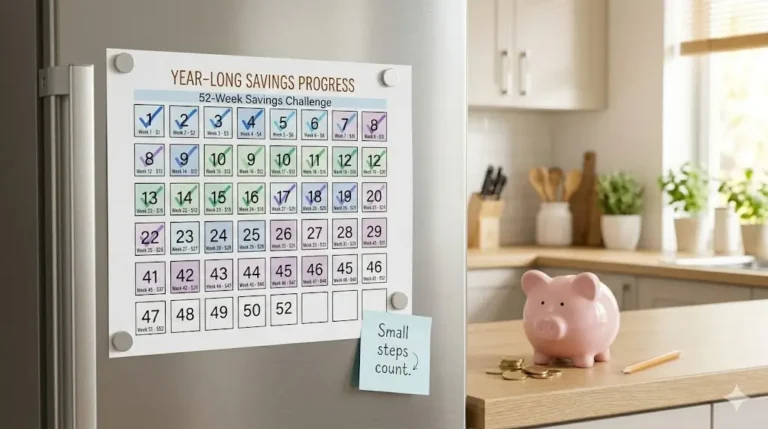
- Gamify Your Savings: Use apps that reward you for saving streaks. The dopamine hit helps replace the rush of spending.
- Find an Accountability Partner: You are the average of the five people you spend the most time with. If your friends spend recklessly, you likely will too.
- Consume Financial Content: Daily intake of podcasts or blogs keeps your goals top-of-mind.
- Visualize the End Game: Don’t just save for a “rainy day”; save for specific work from home freedom or a dream home.
Common Mistakes to Avoid
Even with the best intentions, these psychological traps can derail your progress.
- The Scarcity Trap: Being so afraid to spend that you miss opportunities to invest in yourself or your business. Sometimes, buying a $200 course yields $10,000 in digital income.
- Lifestyle Creep: As your online earnings grow, your expenses rise to match them. This keeps you on the treadmill forever.
- Comparison Syndrome: looking at Instagram influencers and feeling inadequate. Remember, debt speaks loudly, while wealth whispers.
- Neglecting the Offense: You cannot save your way to millions if your income is at the poverty line. Use your discipline to fund new skills that increase your income potential.
Long-Term Sustainability & Growth
A disciplined financial mindset is not a diet; it is a lifestyle change.
The “Wealth Flywheel”
Once your discipline creates a surplus of cash, that cash buys assets (stocks, real estate, websites). These assets generate passive income, which buys more assets. Eventually, your discipline is no longer required to survive—it is simply used to manage abundance.
Generational Impact
Your mindset doesn’t just affect you. By demonstrating financial discipline, you break cycles of poverty for your children and family, teaching them that they control money, not the other way around.
Conclusion
Developing a robust financial mindset is the single most important investment you can make. It is the bridge between earning money and keeping wealth.
By auditing your beliefs, automating your discipline, and avoiding lifestyle creep, you transform your financial trajectory. Remember, the goal isn’t just to have a full bank account—it is to have a life where money is a tool for freedom, not a source of stress.
Ready to master your money? Start today by tracking your spending for just one week. The results might surprise you. Drop a comment below: What is one habit you are changing this month?
Frequently Asked Questions (FAQs)
Can I change my financial mindset if I’ve always been bad with money?
How does financial discipline impact passive income success?
Is a scarcity mindset different from a disciplined financial mindset?
What is the fastest way to improve my financial mindset?
Does financial discipline mean I can never spend money on fun?
Before you go, tap those stars!
Straightforward, no gimmicks, just solid banking advice
I clicked on this article expecting it to push some specific bank or financial product with referral links. I was pleasantly surprised. The advice was unbiased, focused on principles rather than promoting any particular institution, and gave me a clear framework to evaluate my own options. I appreciated that the article addressed the importance of FDIC insurance, automatic transfers, and goal-setting — things that seem obvious but that most people (including me) overlook. The writing was clear and concise, without the usual fluff or overly complex financial jargon. The only reason I’m giving four stars instead of five is that I would have liked even more detail on how to balance saving with paying down debt. Still, this was one of the most practical and trustworthy articles on saving I’ve read in a long time. Highly recommend.
Solid advice that cuts through the noise
I’ve been saving for years, but I kept wondering if my money was actually working as hard as it could be. There’s so much conflicting information out there — regular savings accounts, money market accounts, CDs, high-yield options — it gets confusing fast. This article did an excellent job comparing the options side by side, explaining the pros and cons of each, and helping me figure out which strategy made sense for my situation. I especially appreciated the section on the importance of emergency funds versus long-term savings, and the breakdown of how compound interest really adds up over time. I ended up moving my savings to a high-yield account and setting clearer goals. Practical, well-researched, and genuinely helpful.
Small changes, noticeable results
I’ll be honest — I clicked on this article expecting generic advice like “drive less” (thanks, captain obvious). But I was genuinely impressed. The article breaks down the actual science behind why certain habits affect fuel economy, with real numbers to back it up. I learned that my lead-foot acceleration and speeding were costing me way more than I realized. The section on vehicle maintenance was especially valuable — I didn’t know a dirty air filter could impact mileage that much. The tone was straightforward, no fluff, no upselling expensive products. Just solid, practical advice that actually works. My fuel expenses dropped by about 15% last month without me changing my overall driving needs.
Finally, practical advice that doesn’t require buying a new car
As someone who drives over 400 miles a week for work, gas expenses have been crushing my budget. I’ve read countless articles that basically just say “buy an electric vehicle” — which isn’t helpful when that’s not in my budget. This article was a game-changer. The tips were immediately actionable: combining trips, checking tire pressure (I didn’t realize how much that affects mileage!), and using gas price apps. I started implementing these suggestions last month, and I’ve already saved about $40. The writing was clear, well-organized, and respected that not everyone can just trade in their car. Highly recommend for anyone feeling the pain at the pump.
Perfect for renters who can’t install solar panels
As someone who rents an apartment, I often feel limited when it comes to making my home more energy-efficient. I can’t just install new appliances or add insulation to the walls. This article was a lifesaver because it focused on renter-friendly solutions—things like weatherstripping for doors, smart power strips, and optimizing how I use my existing appliances. The writing was straightforward and didn’t assume I owned a home. My only small critique is that I would have loved even more rent-specific examples, but overall, this was incredibly helpful. My electric bill dropped by about $15 last month!