
Simple Steps for the Best Way to Save for a House
Disclaimer: This article provides financial information for educational purposes. Real estate markets and mortgage requirements vary by location and individual credit profile. Please consult a mortgage professional or financial advisor for personalized advice.
The $50,000 Myth Holding You Back
Did you know that 38% of first-time homebuyers believe they need a 20% down payment to enter the market, when the actual median down payment for first-time buyers is often closer to 6-8%? This “20% myth” is one of the biggest psychological hurdles preventing aspiring homeowners from achieving financial freedom.
If you’re searching for the best way to save for a house, you aren’t just looking for a piggy bank strategy; you’re looking for a roadmap to one of the most significant monetization strategies of your life—home equity. Whether you are generating online earnings from a side hustle or trying to optimize your current revenue streams, the path to homeownership requires a blend of aggressive saving and smart digital income management. In this guide, we break down the exact steps to go from renter to owner without burning out.
Home Journey Calculator
How close are you to getting your keys?
What You’ll Need to Get Started
You don’t need to be a millionaire to start, but you do need a structured foundation. To find the best way to save for a house, gather these resources:
- A Dedicated High-Yield Savings Account (HYSA): This is your primary passive income engine for your deposit.
- Budgeting Software: Tools like YNAB or Mint to track your profit margins at home.
- Credit Monitoring Tool: Your credit score determines your “cost of money.”
- Automatic Transfer Setup: To ensure your digital income moves to savings before you can spend it.
- A “Gap” Fund: A small initial investment (even $500) to act as a psychological starter.
Time Investment & Milestones
Saving for a home is a marathon, not a sprint. However, with consistent effort, the timeline is often shorter than people realize.
- Setup Time: 2-3 hours to audit your finances and set up your saving buckets.
- Daily Commitment: 5 minutes (checking transactions).
- Realistic Timeline: Most beginners, by optimizing their income potential and cutting unnecessary costs, see a viable down payment fund ready in 18 to 36 months.
- Comparison: Unlike a work from home side hustle that pays out weekly, this is a long-term revenue stream buildup that pays off in equity growth.
Step-by-Step Implementation Guide
Step 1: Define Your “Magic Number”
Research the median home price in your target area. Aim for a 3.5% (FHA loan) to 10% down payment goal plus 3% for closing costs. This is your target for financial freedom.
Step 2: Audit Your Cash Flow
Identify “leaks” in your budget. Are you spending online earnings on subscriptions you don’t use? Redirect every “leaked” dollar into your home fund.
Step 3: Automate the “House Tax”
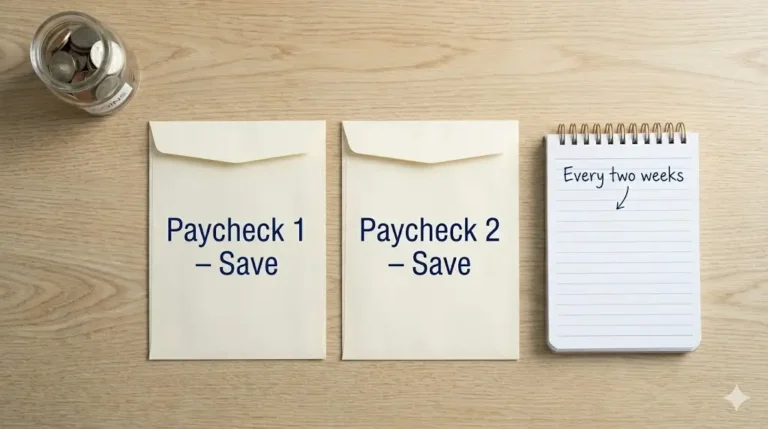
Treat your savings like a mandatory bill. Set an automatic transfer from your paycheck to your HYSA. If you don’t see the money, you won’t spend it.
Step 4: Scale with a “House Hustle”
To reach your goal faster, start a dedicated side hustle. Use 100% of these online earnings specifically for the house. This keeps your lifestyle costs separate from your home goals.

Income Potential: How Homeownership Builds Wealth
Saving for a house isn’t just an expense; it’s an investment in a high-yield asset.
| Year | Renting (Outflow) | Owning (Equity Gain) | Net Wealth Difference |
|---|---|---|---|
| Year 1 | -$24,000 | +$12,000 | +$36,000 |
| Year 5 | -$120,000 | +$75,000 | **+$195,000** |
Note: Data assumes 3% annual appreciation and standard mortgage amortization.
Alternative Methods & Variations
- House Hacking: Buying a duplex and renting out half to cover the mortgage.
- Down Payment Assistance (DPA): State-specific grants that can provide $5k–$20k for first-time buyers.
- The 401k Loan: Using a portion of your retirement for a primary residence (use with caution).
- Shared Equity: Partnering with investors to buy a home with less cash up front.
Best Practices & Optimization Tips
- The 1% Rule: Try to increase your savings rate by 1% every month.
- Lump Sum Wins: Direct tax refunds and work bonuses straight to the house fund.
- Gamification: Create a visual “savings thermometer” on your fridge.
- Optimize Your Score: A 100-point credit score increase can save you $200+ on your monthly mortgage.
Common Mistakes to Avoid
- Ignoring Closing Costs: Most buyers forget the 3-5% needed for taxes and fees at the end.
- Changing Jobs Before Closing: Lenders hate instability; wait until you have the keys.
- New Debt: Do not buy a car or open a credit card while saving for a house.
- The “Dream Home” Trap: Buying too much house early can kill your profit margins for years.
Long-Term Sustainability & Growth
Once you buy the house, the “saving” doesn’t stop. You must transition your house fund into a “Home Maintenance Fund.” Aim to save 1% of the home’s value annually for repairs. This ensures your revenue streams aren’t wiped out by a broken HVAC system. Continue diversifying your digital income to pay down the principal faster and build 100% equity.
Conclusion
The best way to save for a house is a combination of automated discipline and aggressive income scaling. By treating your down payment like a business project, you turn a distant dream into a mathematical certainty.
Ready to start your journey? Use our “Home Deposit Goal Calculator” below to see exactly when you can buy! Drop your target neighborhood in the comments, and subscribe for more financial freedom strategies!
FAQs
How much money can I realistically save in a year?
By cutting “leaks” and starting a $500/month side hustle, many people save $12,000–$15,000 annually.
Do I need prior experience in real estate?
No, but understanding the basics of a mortgage is your best monetization strategy.
What is the initial investment for saving?
$0. Opening a high-yield account is free; the “investment” is your consistency.
How long until I see results?
You will see your balance grow monthly, and most reach “buying power” in 2 years.
Is this method still working in 2026?
Yes. High-yield savings rates remain a top-tier place for short-term cash.
What are the risks involved?
The biggest risk is “lifestyle creep”—spending your savings on temporary wants instead of your permanent home.
Before you go, tap those stars!
Straightforward, no gimmicks, just solid banking advice
I clicked on this article expecting it to push some specific bank or financial product with referral links. I was pleasantly surprised. The advice was unbiased, focused on principles rather than promoting any particular institution, and gave me a clear framework to evaluate my own options. I appreciated that the article addressed the importance of FDIC insurance, automatic transfers, and goal-setting — things that seem obvious but that most people (including me) overlook. The writing was clear and concise, without the usual fluff or overly complex financial jargon. The only reason I’m giving four stars instead of five is that I would have liked even more detail on how to balance saving with paying down debt. Still, this was one of the most practical and trustworthy articles on saving I’ve read in a long time. Highly recommend.
Solid advice that cuts through the noise
I’ve been saving for years, but I kept wondering if my money was actually working as hard as it could be. There’s so much conflicting information out there — regular savings accounts, money market accounts, CDs, high-yield options — it gets confusing fast. This article did an excellent job comparing the options side by side, explaining the pros and cons of each, and helping me figure out which strategy made sense for my situation. I especially appreciated the section on the importance of emergency funds versus long-term savings, and the breakdown of how compound interest really adds up over time. I ended up moving my savings to a high-yield account and setting clearer goals. Practical, well-researched, and genuinely helpful.
Small changes, noticeable results
I’ll be honest — I clicked on this article expecting generic advice like “drive less” (thanks, captain obvious). But I was genuinely impressed. The article breaks down the actual science behind why certain habits affect fuel economy, with real numbers to back it up. I learned that my lead-foot acceleration and speeding were costing me way more than I realized. The section on vehicle maintenance was especially valuable — I didn’t know a dirty air filter could impact mileage that much. The tone was straightforward, no fluff, no upselling expensive products. Just solid, practical advice that actually works. My fuel expenses dropped by about 15% last month without me changing my overall driving needs.
Finally, practical advice that doesn’t require buying a new car
As someone who drives over 400 miles a week for work, gas expenses have been crushing my budget. I’ve read countless articles that basically just say “buy an electric vehicle” — which isn’t helpful when that’s not in my budget. This article was a game-changer. The tips were immediately actionable: combining trips, checking tire pressure (I didn’t realize how much that affects mileage!), and using gas price apps. I started implementing these suggestions last month, and I’ve already saved about $40. The writing was clear, well-organized, and respected that not everyone can just trade in their car. Highly recommend for anyone feeling the pain at the pump.
Perfect for renters who can’t install solar panels
As someone who rents an apartment, I often feel limited when it comes to making my home more energy-efficient. I can’t just install new appliances or add insulation to the walls. This article was a lifesaver because it focused on renter-friendly solutions—things like weatherstripping for doors, smart power strips, and optimizing how I use my existing appliances. The writing was straightforward and didn’t assume I owned a home. My only small critique is that I would have loved even more rent-specific examples, but overall, this was incredibly helpful. My electric bill dropped by about $15 last month!