
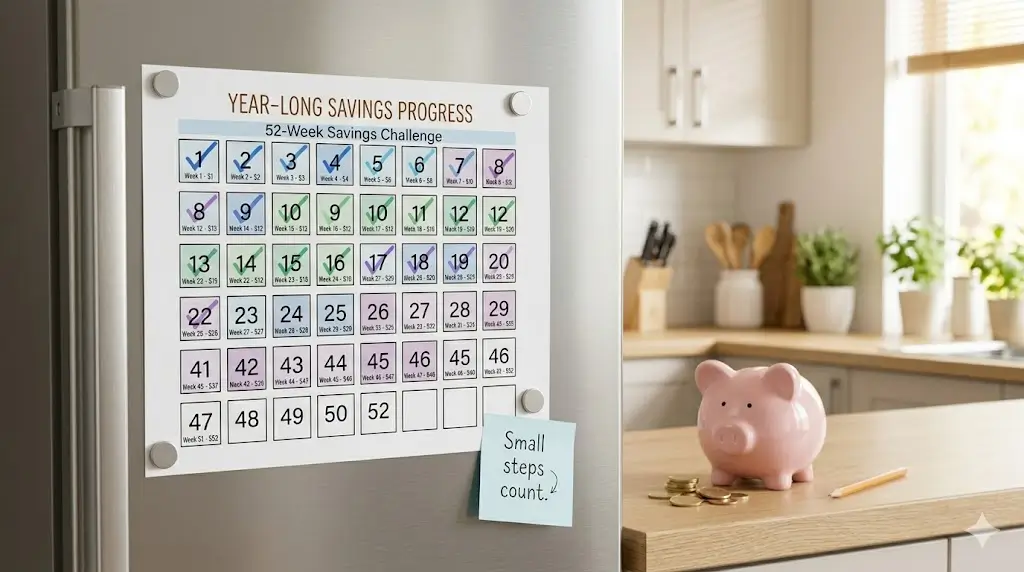
52 Week Money Saving Challenge for Steady Savers
Did you know that 82% of new business ventures and passion projects fail simply because they run out of cash flow? Many aspiring entrepreneurs dream of achieving financial freedom, quitting their daily commute, and building a sustainable work from home lifestyle. Yet, they skip the ONE crucial step required to get there: steadily accumulating the seed capital needed to start.
If aggressive, restrictive budgeting has failed you in the past, the 52 Week Money Saving Challenge is the proven, psychological antidote. By starting incredibly small and gradually increasing your commitment, this challenge tricks your brain into becoming a super-saver without the pain of massive budget cuts.
Whether you want to build a safety net, fund a new side hustle, or generate the initial investment for lasting passive income, this step-by-step guide will show you exactly how to transform your spare change into serious capital over the next year.
What You’ll Need to Get Started
How Much Could YOU Save in 52 Weeks?
Customize your challenge amounts below to discover your true savings potential by the end of the year!
Your 52-Week Potential
$0 / in 1 year!
Ready to make this a reality?
A goal without tracking is just a wish! Keep yourself accountable by securely tracking your daily spending and monthly savings progress.
Track Your Savings Free at TrackThrift.com →You do not need to be a financial guru to succeed at the 52 Week Money Saving Challenge. In fact, the barrier to entry is literally just one dollar. Here is what you need in your toolkit:
- A Dedicated Savings Account: * Premium Option: A High-Yield Savings Account (HYSA) like Ally, Marcus, or SoFi to earn interest on your growing balance.
- Alternative: A traditional piggy bank or cash envelope (though you miss out on compounding interest).
- A Tracking System: * Free Alternative: A printed 52-week PDF tracker or a simple Google Sheet.
- Initial Investment: Exactly $1.00 for your first week.
- Skill Requirements: Basic consistency. If you can remember to brush your teeth, you have the discipline required for this challenge.

Time Investment
Unlike building complex digital income platforms that take hundreds of hours before you see a dime, this challenge yields guaranteed, mathematically certain results if you stick to the schedule.
- Setup Time Required: 15 minutes to open a dedicated savings account and print your tracker.
- Daily/Weekly Time Commitment: 5 minutes per week to manually transfer the funds and check off your progress box.
- Timeline to First Results: Immediate. You will successfully secure your first “win” in week one. Most beginners see a significant mindset shift around day 60, when the weekly transfer amounts begin to feel like a natural part of their budget.
- Comparison: Compared to traditional online earnings that fluctuate, this method provides a steady, predictable accumulation of capital.
Step-by-Step Implementation Guide
Ready to increase your income potential by systematically holding onto more of what you earn? Here is how to execute the challenge flawlessly.
1. Establish Your Goal and Destination
Don’t just save to save. Give your money a job. Decide right now that the $1,378 you save will be used as seed capital for a specific goal—like launching an e-commerce store or investing in dividend ETFs. Open a separate savings account named after your goal.
2. Print and Post Your Visual Tracker
Download a free 52-week tracking chart. Tape it to your refrigerator or bathroom mirror. Visual accountability is a psychological trigger that drastically reduces failure rates.
3. Make Your Week 1 Deposit
In week one, deposit exactly $1.00 into your savings account and cross off week one on your chart.
- Pro Tip: If you want to build momentum early, you can start the challenge in reverse (depositing $52 in week one, $51 in week two, etc.).
4. Optimize Your Daily Habits
As the weeks progress (depositing $20 in week 20, $40 in week 40), the challenge gets harder. You will need to widen your personal profit margins. Start auditing your daily expenses. Skip one coffee shop visit or pack your lunch to naturally free up the exact cash needed for that week’s deposit.
5. Automate When Possible
- Insider Trick: If your bank allows weekly automatic transfers, set them up in advance. The less you have to think about moving the money, the higher your success rate will be.

Income Potential & Earnings Breakdown
The beauty of the 52 Week Money Saving Challenge lies in its compounding momentum. While you aren’t generating external income, you are drastically increasing your retained earnings. Here is the standard payment structure explained:
| Week | Deposit Amount | Total Account Balance |
|---|---|---|
| Week 1 | $1.00 | $1.00 |
| Week 4 (Month 1) | $4.00 | $10.00 |
| Week 26 (Mid-Point) | $26.00 | $351.00 |
| Week 40 | $40.00 | $820.00 |
| Week 52 (Finish Line) | $52.00 | **$1,378.00** |
By simply setting aside a few dollars a week, you naturally accumulate $1,378.00 over the course of a year. If you and a partner do this together, you’ll save $2,756.00.
Alternative Methods & Variations
Personal finance is deeply personal. If the standard method doesn’t fit your cash flow, try these niche-specific variations to fund your monetization strategies:
- The Reverse 52-Week Challenge: Start with $52 in week one and work your way down to $1 in week 52. This is perfect if you are starting in January (when motivation is high) and want it to be easy in December (when holiday spending peaks).
- The Bi-Weekly Challenge: Get paid every two weeks? Combine the weeks. Deposit $3 on your first payday (Week 1 + 2), $7 on your next payday (Week 3 + 4), and so on.
- The Fixed-Rate 52-Week Challenge: If fluctuating amounts stress you out, divide the final goal ($1,378) by 52. Simply automate a flat transfer of **$26.50 every single week**.
Best Practices & Optimization Tips
To guarantee you cross the finish line and maximize your seed capital, implement these advanced strategies:
- Treat it Like a Utility Bill: Your weekly savings deposit is not optional; it is a bill you owe to your future self. Pay it before you buy groceries or entertainment.
- Use Windfalls Wisely: If you receive a tax refund, a bonus, or cash for your birthday, use it to cross off the hardest weeks (Weeks 45-52) on your tracker in advance.
- Community Accountability: Join Facebook groups or Reddit communities (like r/povertyfinance or r/frugal) and share your weekly updates. Public commitment increases follow-through.
Common Mistakes to Avoid
Even steady savers hit roadblocks. Avoid these common pitfalls that derail the challenge:
- Mixing Funds: Keeping your challenge money in your main checking account is a recipe for disaster. You will accidentally spend it. Keep it in a separate, hard-to-access account.
- Quitting During the “Tough Months”: Weeks 40 through 52 require saving over $150+ per month. Many people quit here. Plan ahead by trimming subscriptions or selling unwanted household items online to cover these specific weeks.
- Losing Track: Forgetting to check off a week causes a domino effect of missed payments. Set a recurring alarm on your phone for “Money Transfer Day.”
Long-Term Sustainability & Growth
Successfully finishing the 52 Week Money Saving Challenge proves you have the discipline required to build real wealth. However, true financial freedom requires you to transition from a “saver” to an “investor.”
Once you hit that $1,378 milestone, do not let the money sit idle. Use those funds to establish lasting revenue streams. Invest the money into a broad-market index fund, use it to buy inventory for a scalable e-commerce brand, or purchase high-quality equipment to start a freelance service. By treating this challenge as the launching pad rather than the finish line, you future-proof your finances and accelerate your journey toward ultimate wealth.
Conclusion
The 52 Week Money Saving Challenge is one of the most effective, approachable ways to drastically change your financial habits. By starting with just one dollar and scaling up steadily, you remove the overwhelm of traditional budgeting while accumulating $1,378 in pure, deployable capital.
Remember, financial success is rarely about sudden windfalls; it is about steady, consistent, and intentional action.
Ready to start your journey today? What goal will you use your $1,378 for? Drop your answers and questions in the comments below! Don’t forget to subscribe for weekly money-making strategies, and share your visual tracker progress in our community.
FAQs
How much money can I realistically make or save with this challenge?
If you follow the standard 52-week formula precisely (saving $1 in week one, up to $52 in week 52), you will save exactly $1,378 by the end of the year.
Do I need prior experience with budgeting?
No prior experience is necessary. This challenge is highly recommended for beginners because it starts with an incredibly easy, non-threatening amount ($1) and slowly builds your budgeting muscles over time.
What’s the initial investment to start?
The initial investment is literally just $1.00 for the first week. You do not need to purchase any expensive software or courses to participate.
How long until I see results?
You will see a physical result in your bank account immediately after your first transfer. However, the psychological “results” of feeling financially empowered usually kick in around the two-month mark.
Is this method still working in 2026?
Yes. In fact, during periods of economic inflation, structured, gamified savings methods like this challenge are more effective than ever at helping people intentionally retain their purchasing power.
What are the risks involved?
There are no financial risks in saving your own money. The only risk is losing momentum during the later, more expensive weeks of the challenge. This is easily mitigated by using the “Fixed-Rate” or “Reverse” variations mentioned above.
Before you go, tap those stars!
Straightforward, no gimmicks, just solid banking advice
I clicked on this article expecting it to push some specific bank or financial product with referral links. I was pleasantly surprised. The advice was unbiased, focused on principles rather than promoting any particular institution, and gave me a clear framework to evaluate my own options. I appreciated that the article addressed the importance of FDIC insurance, automatic transfers, and goal-setting — things that seem obvious but that most people (including me) overlook. The writing was clear and concise, without the usual fluff or overly complex financial jargon. The only reason I’m giving four stars instead of five is that I would have liked even more detail on how to balance saving with paying down debt. Still, this was one of the most practical and trustworthy articles on saving I’ve read in a long time. Highly recommend.
Solid advice that cuts through the noise
I’ve been saving for years, but I kept wondering if my money was actually working as hard as it could be. There’s so much conflicting information out there — regular savings accounts, money market accounts, CDs, high-yield options — it gets confusing fast. This article did an excellent job comparing the options side by side, explaining the pros and cons of each, and helping me figure out which strategy made sense for my situation. I especially appreciated the section on the importance of emergency funds versus long-term savings, and the breakdown of how compound interest really adds up over time. I ended up moving my savings to a high-yield account and setting clearer goals. Practical, well-researched, and genuinely helpful.
Small changes, noticeable results
I’ll be honest — I clicked on this article expecting generic advice like “drive less” (thanks, captain obvious). But I was genuinely impressed. The article breaks down the actual science behind why certain habits affect fuel economy, with real numbers to back it up. I learned that my lead-foot acceleration and speeding were costing me way more than I realized. The section on vehicle maintenance was especially valuable — I didn’t know a dirty air filter could impact mileage that much. The tone was straightforward, no fluff, no upselling expensive products. Just solid, practical advice that actually works. My fuel expenses dropped by about 15% last month without me changing my overall driving needs.
Finally, practical advice that doesn’t require buying a new car
As someone who drives over 400 miles a week for work, gas expenses have been crushing my budget. I’ve read countless articles that basically just say “buy an electric vehicle” — which isn’t helpful when that’s not in my budget. This article was a game-changer. The tips were immediately actionable: combining trips, checking tire pressure (I didn’t realize how much that affects mileage!), and using gas price apps. I started implementing these suggestions last month, and I’ve already saved about $40. The writing was clear, well-organized, and respected that not everyone can just trade in their car. Highly recommend for anyone feeling the pain at the pump.
Perfect for renters who can’t install solar panels
As someone who rents an apartment, I often feel limited when it comes to making my home more energy-efficient. I can’t just install new appliances or add insulation to the walls. This article was a lifesaver because it focused on renter-friendly solutions—things like weatherstripping for doors, smart power strips, and optimizing how I use my existing appliances. The writing was straightforward and didn’t assume I owned a home. My only small critique is that I would have loved even more rent-specific examples, but overall, this was incredibly helpful. My electric bill dropped by about $15 last month!