
52 Week Money Saving Challenge: Build Capital to Fund Your Financial Freedom
Did you know that 82% of aspiring entrepreneurs never launch their business simply because they lack the initial seed money? It’s a frustrating reality. Many people spend hours researching passive income ideas, yet they remain stuck because they don’t have the baseline capital to buy web hosting, inventory, or educational courses. If you want to build lasting wealth, your first priority isn’t finding a magic bullet; it’s mastering your cash flow. This is exactly where the 52 Week Money Saving Challenge comes in.
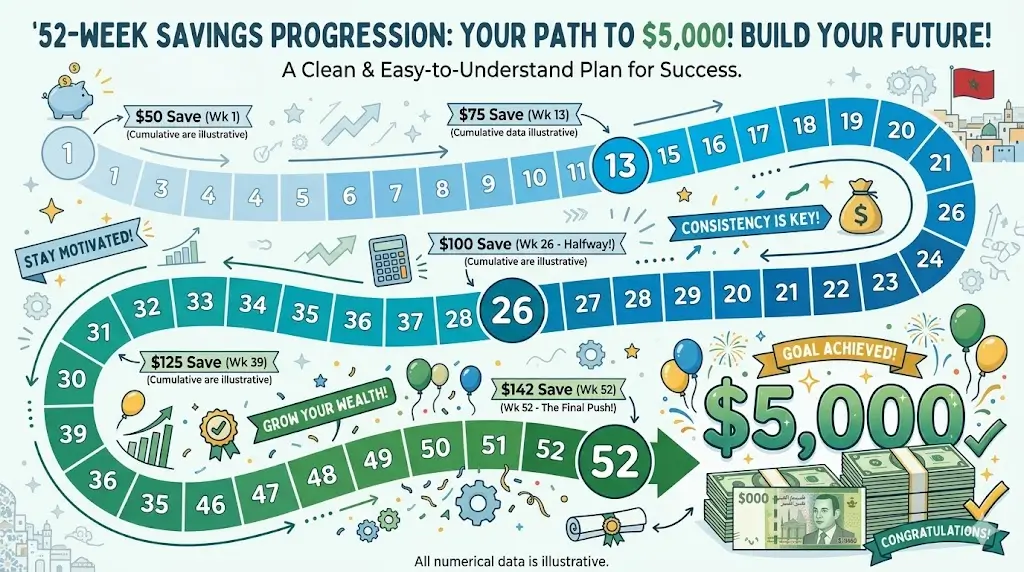
The 52 Week Money Saving Challenge is a structured, gamified approach to putting money aside incrementally. Instead of overwhelming yourself with massive lifestyle cuts, you save just $1 in week one, $2 in week two, and so on. By the end of the year, you will have effortlessly accumulated $1,378. In this comprehensive guide, we’ll show you how to leverage the 52 Week Money Saving Challenge not just to build an emergency fund, but to generate the crucial startup capital needed to launch a side hustle, create digital income, and accelerate your path to true financial freedom.
What You’ll Need to Get Started
The beauty of the 52 Week Money Saving Challenge is its incredibly low barrier to entry. You don’t need a background in finance or expensive software to begin.
Required Tools & Resources:
- A Tracking Chart: A physical printable template or a digital spreadsheet to log your weekly progress.
- A High-Yield Savings Account (HYSA): A separate bank account (yielding 4-5% APY) to ensure your money grows while you save.
- Automation Tools: Most modern banking apps allow you to set up recurring weekly transfers.
Initial Investment Breakdown:
- Financial Cost: $0. (Templates are free online, and opening an HYSA typically has no fee).
- Capital Requirement: You only need $1 to start week one.
Skill Requirements:
- Basic consistency and discipline.
- Beginner-Friendly Alternative: If manually transferring money every week sounds tedious, use micro-saving apps like Acorns or Oportun that round up your spare change to mimic the challenge’s results automatically.
How much could YOU save by following these steps?
Find out exactly how much capital you can build for your future side hustle with our interactive 52-Week calculator.
Your Projection is Ready! 📊
Enter your details below to unlock your personalized 52-week wealth projection and see which business you can launch!
Awesome, ! Here is your personalized plan:
$0
$0
$0
Based on our guide, this capital unlocks the following level of financial freedom for you:
Business Level
Description
Time Investment
Building wealth requires patience, but executing this strategy takes almost zero time away from your busy schedule.
- Setup Time Required: 15 to 20 minutes (to open an HYSA and print your tracking chart).
- Daily/Weekly Time Commitment: 2 to 5 minutes per week to initiate the transfer and check off the box on your chart.
- Timeline to First Results: Most beginners feel a psychological shift and see tangible cash buildup in 60-90 days. By week 52, you've completed the goal.
- Compared to Traditional Methods: Unlike working overtime at a traditional job—which trades hours for dollars—this system takes minutes to manage. It frees up your time to focus on learning new monetization strategies rather than stressing over bills.
Step-by-Step Implementation Guide
Step 1: Choose Your Challenge Format
There is no "one size fits all." While the standard 52 Week Money Saving Challenge starts with $1 and ends with $52, you can customize it. If you have higher expenses in December, try the "Reverse Challenge" (start with $52 in week one and end with $1 in week 52).
Step 2: Set Up a Dedicated "Seed Capital" Account
Do not keep these savings in your primary checking account. It will get spent. Open a high-yield savings account (HYSA) specifically designated for your future side hustle or emergency fund. Out of sight means out of mind.
Step 3: Schedule Your Weekly "Payday"
Pick a specific day of the week—like Sunday evening or Friday morning—to make your transfer. Consistency is the secret sauce here.
- Pro Tip: Set an alarm on your phone named "Fund My Financial Freedom" to remind you to make the transfer.
Step 4: Gamify the Process
Print out your 52 Week Money Saving Challenge chart and put it somewhere highly visible, like your refrigerator or bathroom mirror. The physical act of checking off a box releases dopamine, keeping you motivated to continue.
Step 5: Plan Your Reinvestment Strategy
Before you even finish, know what you will do with the $1,378. Will you use it to buy e-commerce inventory? Pay for a work from home certification? Having a clear goal transforms the money from "just savings" into active capital.

Income Potential & Earnings Breakdown
Saving money is defensive; investing it is offensive. Let's look at the income potential of the $1,378 generated by the 52 Week Money Saving Challenge when deployed intelligently.
| Savings Milestone | Capital Available | Potential Monetization Strategies | Projected ROI / Income Potential |
| Month 3 (Week 12) | $78 | Domain name, hosting, basic tools | Launch a blog ($50-$200/mo potential) |
| Month 6 (Week 26) | $351 | Premium courses, digital marketing tools | Freelance setup ($500-$1000/mo potential) |
| Month 9 (Week 39) | $780 | Ad spend, LLC formation, software | Affiliate marketing ($1k-$3k/mo potential) |
| Month 12 (Week 52) | **$1,378** | E-commerce inventory, custom web dev | Scalable online business ($5k+/mo potential) |
Case Study: Sarah completed the 52-week challenge and used her $1,378 to buy a refurbished laptop and a subscription to graphic design software. She started a print-on-demand side hustle. Within six months, her initial $1,378 investment was generating over $800 a month in semi-passive income.
Alternative Methods & Variations
If the traditional ascending model doesn't fit your cash flow, try these niche-specific variations:
- The Reverse 52 Week Challenge: Start with $52 in week 1 and decrease by $1 each week. This is great for front-loading your savings when you have high motivation.
- The Bi-Weekly Challenge: If you get paid every two weeks, adjust the chart to make 26 larger deposits instead of 52 smaller ones.
- The 52 Week "Side Hustle" Challenge: Instead of cutting expenses to save the money, challenge yourself to earn the weekly amount through gig apps, surveys, or freelance work from home jobs. This trains your brain to generate online earnings.
- The $5,000 Multiplier: For higher earners, multiply every weekly amount by 4 to save over $5,500 in a year.
Best Practices & Optimization Tips
To guarantee you cross the finish line without dipping into the funds, follow these efficiency hacks:
- Audit Your Profit Margins: Treat your personal finances like a business. To easily find the money for weeks 40-52 (the most expensive weeks), audit your recurring subscriptions and cut the unused ones.
- Use Cashback to Fund It: Route your daily purchases through cashback portals (like Rakuten) or use cashback credit cards. Use this "free money" to cover your weekly challenge deposits.
- Join a Community: Join Reddit forums like r/personalfinance or dedicated Facebook groups. Doing the challenge alongside thousands of others dramatically increases your success rate.
Common Mistakes to Avoid
The 52 Week Money Saving Challenge is simple, but simple doesn't always mean easy. Avoid these common pitfalls:
- Quitting After a Missed Week: Statistics show that over 40% of people abandon savings challenges if they miss a single deposit. If you miss a week, do not quit. Just pick up where you left off.
- Keeping the Money Accessible: If your challenge money is linked to your daily debit card, an impulsive purchase will wipe it out. Keep it in a separate institution.
- Having No "Why": Saving money just to have money gets boring fast. Connect this challenge directly to your desire for financial freedom or funding a specific business idea.
Long-Term Sustainability & Growth
Completing the 52 Week Money Saving Challenge is a massive achievement, but it is just phase one of your wealth-building journey.
- Transitioning to Investing: Once you hit your $1,378 goal, pivot. Take the habit you've built (saving $50+ a week) and start automating that exact amount into an S&P 500 index fund or your new business venture.
- Diversification: Use your new capital to establish multiple revenue streams. Don't put all $1,378 into one high-risk project.
- Future-Proofing: Financial freedom is achieved through scalable systems. As your online earnings grow, automate your savings so you are consistently putting away 20% of your income without thinking about it.
Conclusion
The 52 Week Money Saving Challenge is the ultimate gateway drug to financial independence. By starting with just $1, you slowly build the discipline, mindset, and capital required to change your life. Whether you want to establish an emergency fund or generate the seed money for a lucrative side hustle, this proven framework makes it achievable. Don't wait until January 1st to begin—start with your first dollar today.
Ready to start your journey? Drop a comment below and let us know what business you plan to fund with your $1,378! Subscribe to our newsletter for weekly money-making strategies, and be sure to share your progress in our community.
FAQs
How much money can I realistically make from completing this challenge?
The standard 52 Week Money Saving Challenge yields exactly $1,378 in saved capital. However, if you place this money in a High-Yield Savings Account, you will earn slightly more through compound interest. If you reinvest it into a business, the earning potential is virtually unlimited.
Do I need prior experience with budgeting to succeed?
Not at all. This challenge is universally recommended precisely because it requires zero financial expertise. It eases you into saving by starting with just $1 in the first week.
What's the initial investment to start?
You only need $1 to start week one of the challenge, plus a free printable tracker and a savings account.
How long until I see meaningful results?
While you'll have some cash saved immediately, most participants feel a profound sense of financial momentum and behavioral change around Week 15, when the weekly contributions start becoming more substantial.
Is the 52 Week Money Saving Challenge still relevant in 2026?
Absolutely. While inflation changes the buying power of money, the core psychological benefit of gamifying your savings and building financial discipline remains incredibly effective in 2026 and beyond.
What are the risks involved with this method?
There are no financial risks to saving money. The only "risk" is inflation slightly outpacing your savings account's interest rate, which is why it is crucial to eventually transition this saved capital into investments or income-generating assets.
Before you go, tap those stars!
Straightforward, no gimmicks, just solid banking advice
I clicked on this article expecting it to push some specific bank or financial product with referral links. I was pleasantly surprised. The advice was unbiased, focused on principles rather than promoting any particular institution, and gave me a clear framework to evaluate my own options. I appreciated that the article addressed the importance of FDIC insurance, automatic transfers, and goal-setting — things that seem obvious but that most people (including me) overlook. The writing was clear and concise, without the usual fluff or overly complex financial jargon. The only reason I’m giving four stars instead of five is that I would have liked even more detail on how to balance saving with paying down debt. Still, this was one of the most practical and trustworthy articles on saving I’ve read in a long time. Highly recommend.
Solid advice that cuts through the noise
I’ve been saving for years, but I kept wondering if my money was actually working as hard as it could be. There’s so much conflicting information out there — regular savings accounts, money market accounts, CDs, high-yield options — it gets confusing fast. This article did an excellent job comparing the options side by side, explaining the pros and cons of each, and helping me figure out which strategy made sense for my situation. I especially appreciated the section on the importance of emergency funds versus long-term savings, and the breakdown of how compound interest really adds up over time. I ended up moving my savings to a high-yield account and setting clearer goals. Practical, well-researched, and genuinely helpful.
Small changes, noticeable results
I’ll be honest — I clicked on this article expecting generic advice like “drive less” (thanks, captain obvious). But I was genuinely impressed. The article breaks down the actual science behind why certain habits affect fuel economy, with real numbers to back it up. I learned that my lead-foot acceleration and speeding were costing me way more than I realized. The section on vehicle maintenance was especially valuable — I didn’t know a dirty air filter could impact mileage that much. The tone was straightforward, no fluff, no upselling expensive products. Just solid, practical advice that actually works. My fuel expenses dropped by about 15% last month without me changing my overall driving needs.
Finally, practical advice that doesn't require buying a new car
As someone who drives over 400 miles a week for work, gas expenses have been crushing my budget. I’ve read countless articles that basically just say “buy an electric vehicle” — which isn’t helpful when that’s not in my budget. This article was a game-changer. The tips were immediately actionable: combining trips, checking tire pressure (I didn’t realize how much that affects mileage!), and using gas price apps. I started implementing these suggestions last month, and I’ve already saved about $40. The writing was clear, well-organized, and respected that not everyone can just trade in their car. Highly recommend for anyone feeling the pain at the pump.
Perfect for renters who can't install solar panels
As someone who rents an apartment, I often feel limited when it comes to making my home more energy-efficient. I can’t just install new appliances or add insulation to the walls. This article was a lifesaver because it focused on renter-friendly solutions—things like weatherstripping for doors, smart power strips, and optimizing how I use my existing appliances. The writing was straightforward and didn’t assume I owned a home. My only small critique is that I would have loved even more rent-specific examples, but overall, this was incredibly helpful. My electric bill dropped by about $15 last month!